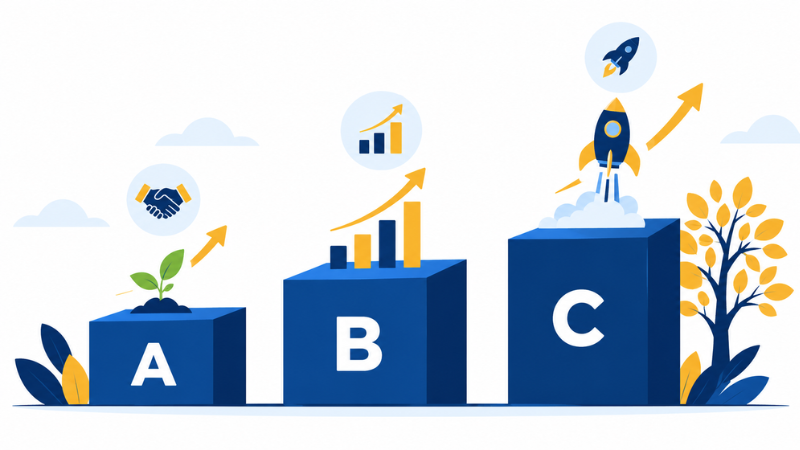
A startup’s fundraising journey rarely happens in one shot. It happens in rounds — and each one has a letter attached to it. Here’s what Series A, B, and C actually mean, who writes the checks, and why the “next round” gets harder every single time.
Quick answer: Series funding is the staged process by which a startup raises money from investors in exchange for equity, with each round (A, B, C…) marking a new stage of growth, a higher valuation, and a different type of investor. Series A is usually about proving the business model works. Series B is about scaling it. Series C is about dominating the market or preparing for an IPO.
Who Participates in Series A, B, and C Funding Rounds?
Each round attracts a different crowd of investors, and that shift itself tells you a lot about where a company stands.
Series A is where angel investors start stepping aside and venture capital firms step in. At this stage, a startup usually has a working product and some early revenue or user traction, but not yet a repeatable, scalable business model. VCs writing Series A checks are betting on potential — they want to see a clear path to a large market, not just a good idea.
Series B brings in larger VC firms and sometimes private equity players who specialize in scaling companies that have already found product-market fit. The company isn’t proving it can work anymore — it’s proving it can grow fast without falling apart. Series B money typically goes toward hiring, expanding into new markets, and building out sales and marketing teams.
Series C is where the investor pool gets noticeably more conservative and more institutional. Hedge funds, investment banks, private equity firms, and sometimes sovereign wealth funds join the table. By this point, the startup is a proven business looking to scale aggressively, acquire smaller competitors, enter international markets, or prepare for an eventual IPO or acquisition. The risk appetite here is lower because the company has real numbers to evaluate — not just a pitch deck.
| Round | Typical Investors | Company Stage |
|---|---|---|
| Series A | VC firms, some angel investors | Early product, finding product-market fit |
| Series B | Larger VC firms, growth equity funds | Proven model, scaling operations |
| Series C | Hedge funds, private equity, investment banks | Market expansion, acquisitions, pre-IPO |
Series Funding and Funding Valuation
Valuation is where the real negotiation happens, and it changes character with every round.
At the Series A stage, valuation is part science, part storytelling. Investors look at market size, early traction, and team strength, but a lot of the number still comes down to how convincingly the founders can argue “this could be huge.” A typical Series A raise might value a company anywhere from $10 million to $15 million upward, though this varies wildly by sector and geography.
By Series B, the guesswork shrinks. Investors now have real revenue trends, customer retention numbers, and unit economics to study. Valuations climb accordingly — often into the tens or hundreds of millions — because the company is being priced on demonstrated performance, not just projections.
Series C valuations are closer to what you’d see in public markets. Investors run detailed financial models, stress-test growth assumptions, and compare the company against listed competitors. A strong Series C round can push valuations past the billion-dollar mark, especially for companies clearly heading toward an IPO.
One thing worth remembering: a higher valuation isn’t automatically a win for founders. It raises the bar for every future round. If growth doesn’t keep pace, the next raise can come at a lower valuation than the last one — something investors call a “down round,” and it’s rarely good news for existing shareholders.
Read Also –What Is a Unicorn Company?
Downsides to Series Fundings
Series funding gets glamorized in startup media, but it comes with real trade-offs that founders feel long after the check clears.
- Equity dilution. Every round means giving away another slice of the company. Founders who raise Series A, B, and C in succession can end up owning a much smaller percentage of the business they built.
- Loss of control. New investors usually want board seats and a say in major decisions. By Series C, founders often share — or lose — control over strategic direction.
- Pressure to grow fast. VC money comes with expectations. Investors want returns within a defined timeline, which can push founders toward aggressive growth even when a slower, steadier path might be healthier for the business.
- Down-round risk. If a company underperforms between rounds, the next raise may come at a lower valuation, hurting morale, employee stock options, and investor confidence all at once.
- Time and distraction. Fundraising is a full-time job in itself. Founders can spend months on investor meetings and due diligence — time not spent running the company.
Differences Between Series A, B, C and D Funding
Not every company needs a Series D, but for those that do, it usually signals one of two things: the company is scaling toward a major exit, or it needs a financial bridge before going public. Here’s how all four rounds stack up side by side.
| Factor | Series A | Series B | Series C | Series D |
|---|---|---|---|---|
| Goal | Prove the business model | Scale operations | Expand market share | Bridge to IPO or pivot |
| Investors | VC firms, angels | Growth-stage VCs | Hedge funds, PE, banks | PE firms, late-stage investors |
| Company maturity | Early, unproven at scale | Proven model, scaling | Established, expanding | Mature, pre-exit |
| Risk level for investors | High | Moderate | Lower | Lowest |
| Typical use of funds | Product development, team building | Marketing, hiring, new markets | Acquisitions, global expansion | IPO prep, major restructuring |
Not every startup follows this path in a straight line either. Some skip Series B entirely if they reach profitability early; others raise a Series C, D, and even E before finally going public. There’s no fixed rulebook — the letters simply mark milestones, not a mandatory ladder.
FAQs on Series Funding
Seed funding helps startups develop their product and prove the business idea. Series A usually comes after early traction and is used to scale the business.
Founders often sell around 15%–25% of the company in a Series A round, but the percentage varies based on valuation, investor demand, and negotiations.
No. Some startups become profitable after Series A and do not raise more funding. Others raise additional rounds to support rapid growth or capital-intensive development.
A startup may cut costs, extend its runway, raise a bridge round, seek an acquisition, or shut down if it cannot secure additional funding.
No. A company can raise Series D, E, or later rounds before an IPO. Series C generally represents a more mature, proven business, but the timing of an IPO depends on the company and market conditions.
Founders and investors negotiate the valuation based on factors such as revenue, growth, market size, comparable companies, business potential, and investor demand.