
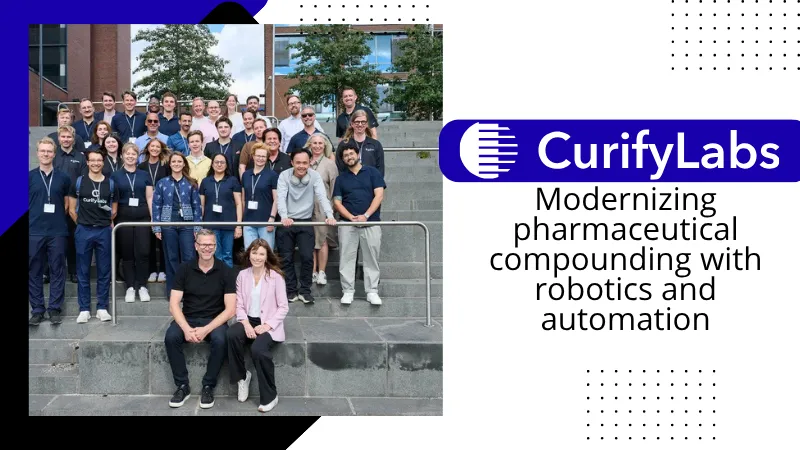
CurifyLabs: A Startup Making Personalized Medicine More Accessible
Personalized medicine is becoming an important part of modern healthcare. However, preparing medicines that meet the specific needs of individual patients remains a challenge for many pharmacies and hospitals. Traditional pharmaceutical compounding often involves manual work, careful measurements, and time-consuming procedures that require considerable expertise from pharmacists.
Finnish healthtech startup CurifyLabs aims to change this process through automation, robotics, and pharmaceutical technology.
Founded in 2021 by Charlotta Topelius and Niklas Sandler Topelius in Helsinki, Finland, CurifyLabs is developing solutions that help pharmacies and hospital pharmacies prepare customized medicines more efficiently and consistently. The company’s goal is to modernize a traditional healthcare workflow while supporting the growing need for patient-specific treatments.
Rather than replacing the expertise of pharmacists, CurifyLabs focuses on giving healthcare professionals better tools to prepare personalized medicines with greater efficiency, quality control, and consistency.
The company’s journey began with a problem familiar to many healthcare professionals. By combining pharmaceutical knowledge with modern technology, its founders saw an opportunity to improve how customized medicines are prepared and delivered.
The Personal Experience That Inspired CurifyLabs
Many successful startups begin by identifying a problem that established industries have struggled to solve. For CurifyLabs, the inspiration came from a personal connection to pharmacy work.
Niklas Sandler Topelius learned about the challenges of pharmaceutical compounding through his mother, an experienced hospital pharmacist. Her experiences helped him understand the amount of time, precision, and manual effort required to prepare medicines for individual patients.
Unlike mass-produced medicines, compounded medications are prepared to meet specific requirements. A patient may need a particular dosage, a different formulation, or a medicine in a form that is easier to administer. In these situations, pharmacists play an important role in adapting treatments to individual needs.
However, traditional compounding can involve repetitive manual tasks and several steps that demand close attention. Depending on the formulation and the process involved, pharmacists must carefully measure ingredients, follow established procedures, document their work, and check the quality of the finished preparation.
These requirements make compounding essential but resource-intensive.
Through his mother’s experiences, Niklas recognized that technology could help address some of these challenges. Instead of accepting manual preparation as the only practical approach, he began exploring how automation could support pharmacists and improve the consistency of their work.
Together with Charlotta Topelius, he developed this idea into a business opportunity. The founders set out to create a technology-driven solution that would help modernize pharmaceutical compounding without losing sight of its central purpose: meeting individual patients’ needs.
Why Personalized Medicine Needs Better Technology
The pharmaceutical industry has developed sophisticated systems for manufacturing medicines on a large scale. Yet preparing smaller quantities of customized medication presents a different set of challenges.
Hospitals and pharmacies may need to produce formulations for patients whose requirements cannot be met by readily available commercial products. These needs can arise from differences in dosage requirements, difficulties swallowing conventional tablets, or the need for a specific formulation.
Pharmaceutical compounding helps address these situations. It gives qualified professionals a way to prepare medicines for particular patients when appropriate commercial alternatives are unavailable or unsuitable.
The process, however, can be difficult to scale. Manual preparation requires trained staff, dedicated time, suitable equipment, and careful quality checks. As healthcare providers face pressure to manage workloads and use resources efficiently, improving this workflow has become an important opportunity for innovation.
For CurifyLabs, the challenge was to bring greater standardization and automation to a process that still depends heavily on professional expertise.
The company saw potential in combining software, robotics, standardized formulation materials, and quality-control measures within a single system. Such an approach could help pharmacies manage preparation more efficiently while maintaining oversight of the process.
This became the foundation of CurifyLabs’ business model.
Bringing Automation Into Pharmaceutical Compounding
After identifying the problem, CurifyLabs began developing technology to make customized medicine preparation more streamlined.
One of the key ideas behind its approach is to use automation for suitable compounding tasks that have traditionally required substantial manual involvement. Technologies associated with 3D printing and precision dispensing offered a possible way to improve how ingredients are measured, handled, and combined.
The opportunity was not simply to make medicine preparation faster. It was to create a more structured process in which equipment, software, formulation information, and quality checks work together.
CurifyLabs developed its Compounding System Solution (CSS) around this concept. The platform brings together several components designed to support non-sterile pharmaceutical compounding.
These include compounding robotics, software, GMP-manufactured excipient bases, in-process quality-control features, and a formulation library.
Each component serves a different purpose. Robotics can support repeatable preparation tasks. Software helps organize the workflow. Standardized excipient bases provide formulation materials, while the formulation library supports the selection and use of suitable preparations. Quality-control features help professionals monitor the process.
Together, these elements are intended to make pharmaceutical compounding more consistent and manageable.
The approach also reflects a broader trend in healthcare technology. Automation is increasingly being explored not only for large-scale manufacturing but also for specialized workflows where precision, documentation, and repeatability matter.
For CurifyLabs, this creates an opportunity to bring modern manufacturing principles into pharmacies and hospital settings.
CurifyLabs’ Compounding System Solution
The company’s Compounding System Solution is central to its effort to modernize personalized medicine preparation.
Traditional compounding methods can require pharmacists to carry out multiple preparation steps manually. CurifyLabs aims to organize and automate appropriate parts of this workflow through an integrated platform.
1. Robotics Inspired by 3D Printing
Robotics is an important part of CurifyLabs’ approach. The company draws on automation concepts associated with 3D printing to support the preparation of customized formulations.
In conventional 3D printing, equipment follows digital instructions to deposit or build material in a controlled manner. Related automation principles can be applied to certain pharmaceutical preparation tasks, where controlled dispensing and repeatability are important.
For compounding, the objective is to help reduce the burden of repetitive manual work and make preparation more consistent. The technology is designed to support pharmacists rather than eliminate the need for professional supervision.
2. GMP-Manufactured Excipient Bases
Excipients are ingredients used alongside active pharmaceutical ingredients to help create a suitable medicine formulation. Depending on the preparation, they can influence properties such as consistency, stability, texture, and ease of administration.
CurifyLabs incorporates GMP-manufactured excipient bases into its system. GMP, or Good Manufacturing Practice, refers to established requirements intended to help ensure products are consistently manufactured and controlled according to applicable quality standards.
Using standardized formulation materials can support a more structured compounding workflow. However, the suitability of any formulation still depends on the medicine, its ingredients, the intended patient, and the relevant professional and regulatory requirements.
3. Integrated In-Process Quality Control
Quality is particularly important when medicines are prepared for individual patients. The finished product must meet the applicable requirements for its intended use.
CurifyLabs includes in-process quality-control features in its platform. These are designed to support oversight during preparation rather than relying solely on manual checks at the end of the process.
A more integrated workflow can help healthcare professionals monitor relevant preparation steps and follow established procedures. The precise checks required depend on the formulation, equipment, and applicable standards.
Automation does not remove the need for validation, appropriate documentation, or professional responsibility. Instead, the aim is to make quality management a more organized part of the preparation process.
4. Software and a Formulation Library
Software is another important element of the CurifyLabs platform. It connects the preparation process with the information and instructions needed to support specific formulations.
A comprehensive formulation library can help pharmacists work with established formulation information instead of repeatedly building preparation processes from scratch.
When combined with suitable equipment and standardized materials, this digital layer can help organize workflows and support more consistent preparation practices.
The result is an integrated approach in which software, formulation knowledge, and automation work together.
From Early Product Development to Clinical Use
Developing healthcare technology requires more than creating a promising product. A solution must also fit into real clinical workflows, meet relevant requirements, and demonstrate that it can be used appropriately in practice.
CurifyLabs has progressed beyond the initial idea stage. According to the company, its Compounding System Solution is in clinical use with customers in Europe and the United States.
This is an important step in the development of a healthtech startup. Working with pharmacies and hospital pharmacies gives a company the opportunity to address practical considerations such as staff training, workflow integration, preparation requirements, and quality management.
Healthcare environments also differ from one another. A hospital pharmacy may have different operational needs from a community pharmacy, and the requirements for one type of formulation may differ from those for another.
For this reason, successful adoption depends on more than the capabilities of the equipment. The solution must work within the professional, operational, and regulatory environment in which it is used.
CurifyLabs’ focus on an integrated compounding platform reflects this wider challenge. By bringing together robotics, software, formulation materials, and quality-control features, the company is attempting to address multiple parts of the workflow rather than offering automation as a standalone tool.
The Business Opportunity Behind CurifyLabs
CurifyLabs operates at the intersection of healthcare, pharmaceutical technology, and automation. Its business opportunity comes from addressing a specialized but important part of the medicine supply process.
Personalized treatments can create additional demands on pharmacies and hospital pharmacies. When commercial medicines do not meet a patient’s requirements, compounding may provide an alternative where clinically appropriate and legally permitted.
Yet manual workflows can limit how efficiently a pharmacy manages this work. A technology platform that helps organize preparation and standardize suitable tasks may therefore offer value to healthcare providers.
CurifyLabs’ business model is built around providing a compounding system rather than focusing on a single piece of equipment. Its offering combines hardware, software, formulation materials, and supporting pharmaceutical knowledge.
This integrated model can help distinguish the company from businesses that concentrate exclusively on robotics or pharmaceutical ingredients.
It also positions CurifyLabs within the broader movement toward digitizing healthcare operations. Across the sector, technology companies are looking for ways to improve workflows, strengthen process oversight, and help professionals use their time more effectively.
However, commercial growth in healthcare technology depends on several factors. Customers must see practical benefits, systems must fit existing operations, and providers must be confident that the technology meets their quality and compliance obligations.
For CurifyLabs, continued adoption will depend on demonstrating value in real-world settings while supporting the needs of pharmacists and healthcare organizations.
What Makes CurifyLabs’ Approach Different?
CurifyLabs is not simply trying to introduce a robot into a pharmacy. Its approach is based on combining multiple parts of the compounding process within a single system.
First, it addresses a specific workflow rather than attempting to automate every part of healthcare. This focused approach allows the company to concentrate on the challenges associated with preparing personalized medicines.
Second, its system combines equipment with software and formulation resources. This matters because effective automation often depends on the instructions, materials, and quality processes surrounding the machine itself.
Third, the company focuses on non-sterile compounding. This defines a specific area of pharmaceutical preparation in which its platform is intended to operate. Sterile compounding involves additional requirements and should not be assumed to fall within the same capabilities.
Finally, CurifyLabs’ stated objective is to support pharmacists in delivering patient-specific therapies. The technology is intended to improve the process while preserving the role of trained healthcare professionals.
These elements form the basis of the company’s approach to pharmaceutical innovation.
Challenges CurifyLabs Must Navigate
Although automation offers opportunities, introducing new technology into pharmaceutical compounding comes with challenges.
Meeting Regulatory and Quality Requirements
Medicines are subject to strict quality and safety expectations. A technology platform must be suitable for its intended use, and its workflows must comply with the requirements applicable in each market.
CurifyLabs must continue to address these considerations as it develops its products and works with healthcare providers across different jurisdictions.
Integrating With Existing Pharmacy Workflows
Pharmacies already have established procedures for handling prescriptions, preparing medicines, maintaining records, and checking finished products.
Introducing an automated platform requires staff to understand the system and incorporate it into their existing responsibilities. Training, workflow design, maintenance, and technical support can all influence adoption.
Demonstrating Practical and Economic Value
Healthcare organizations must consider the cost of new equipment, implementation, training, and ongoing operation.
For automation to make commercial sense, providers need evidence that it offers meaningful benefits in their particular setting. These may include improved workflow efficiency, reduced manual workload, or more consistent preparation processes.
The size of the benefit will depend on how the system is used and the needs of each pharmacy.
Expanding Across Different Markets
CurifyLabs serves a specialized area of healthcare, and international expansion requires an understanding of local pharmaceutical practices and regulatory frameworks.
The company must also establish relationships with customers and ensure that its technology can support the requirements of different pharmacy environments.
Addressing these challenges will be important as the startup seeks to expand its presence.
The Future of CurifyLabs and Personalized Medicine
Healthcare is increasingly focused on treatments that reflect individual patient needs. Although not every treatment requires a customized formulation, there are situations in which personalization plays an important role.
This creates an opportunity for technology companies to improve the processes that support individualized care.
CurifyLabs is working toward a future in which pharmaceutical compounding can be more standardized, digitally supported, and efficient. Its combination of robotics, formulation resources, software, and quality-control features offers one approach to that goal.
If adopted more widely, systems of this kind could help pharmacies manage suitable compounding tasks and make better use of staff time. They may also help healthcare providers organize preparation workflows more consistently.
However, the long-term impact will depend on clinical suitability, regulatory compliance, practical performance, and the ability of customers to justify the investment.
The wider development of personalized medicine will also depend on many other factors, including advances in diagnostics, pharmaceutical research, and healthcare delivery. Compounding automation represents one part of this broader transformation.
For CurifyLabs, the opportunity lies in solving a practical problem within that changing landscape.
Conclusion: A Personal Insight Becomes a Healthtech Startup
The story of CurifyLabs demonstrates how a practical challenge in healthcare can inspire a technology business.
Founded in Helsinki in 2021 by Charlotta Topelius and Niklas Sandler Topelius, the company emerged from a recognition that traditional pharmaceutical compounding could benefit from modern automation and digital tools.
The founders developed that insight into a platform combining robotics, software, standardized excipient bases, formulation resources, and in-process quality control. The company reports that its Compounding System Solution is now in clinical use with customers in Europe and the United States.
CurifyLabs is working to modernize an essential but often labor-intensive part of pharmacy practice. Its progress highlights how startups can create opportunities by applying technology to established industries and focusing on problems faced by professionals every day.
As healthcare continues to explore more personalized approaches to treatment, the need for practical and reliable preparation methods will remain important. CurifyLabs is positioning itself to contribute to that development by helping pharmacies and hospitals rethink how customized medicines are prepared.
Its journey is a reminder that meaningful innovation does not always begin with a completely new invention. Sometimes, it starts with understanding an existing problem and finding a better way to solve it.