
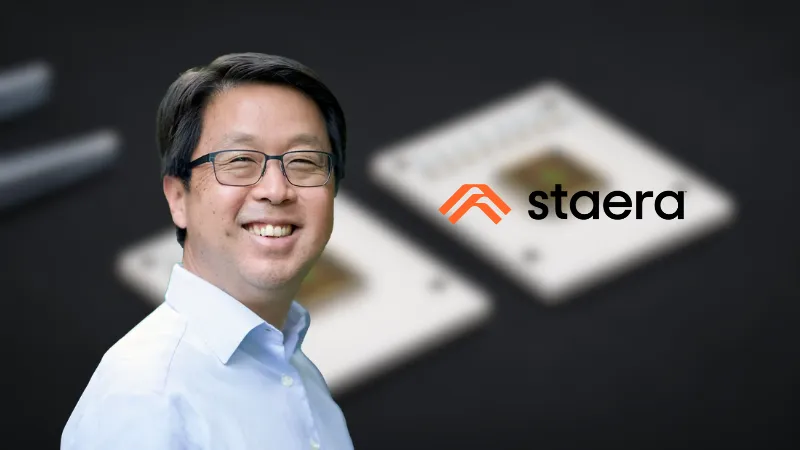
Staera Semiconductor, a San Francisco-based semiconductor company, has emerged from stealth with $4.6 million in pre-seed funding to develop optical data links that are built directly into silicon chips. The round was led by Openspace Capital, with participation from SGInnovate, Black Kite Capital, 28 Holdings, In Group and Decimus Technologies.
Formerly known as New Silicon Corporation (NSC), Staera is developing technology to address a growing challenge in AI infrastructure: moving data between chips. As AI processors become more powerful, traditional copper connections are struggling to transfer data quickly and efficiently across larger computing systems.
Led by CEO Dr Andrew Kim, the company plans to use the funding to advance its technology, expand its team in the United States and strengthen relationships with customers and supply chain partners.
“AI’s bottleneck is no longer how fast chips compute, but how fast and far they can move data,” says CEO Dr Andrew Kim. “Copper performance plummets over the millimeter-to-meter distances that matter most in AI accelerators, and bolt-on optics add power and complexity. We build the light into the chip, the entire optical link inside a chip, so the connection gets smaller, cooler and faster with each generation. This funding takes Lightwire from the lab to customers, and the Staera name marks that move.”
Replacing Copper Connections with Optical Links
Modern AI systems rely on connections between processors, memory and other hardware components to move large volumes of data. However, copper wiring faces limitations as data transfer speeds and distances increase.
Staera says copper’s electrical performance can decline significantly across the distances involved in connecting chips, circuit boards and server racks. Improving data transfer through conventional copper connections can also increase power consumption.
The company believes optical connections, which use light instead of electrical signals to transfer data, can help overcome these limitations.
Its first product, Lightwire, is designed to generate light directly inside silicon chips and use it to move data between components. Rather than relying on separate optical parts attached to a chip, Staera integrates the light source and other components of the optical connection into the silicon manufacturing process.
Lightwire Integrates Optical Technology into Silicon Chips
Staera combines silicon CMOS technology, gallium nitride (GaN) LED light sources and silicon nitride waveguides on a single wafer.
The company’s technology is designed to integrate optical links into silicon interposers and bridge chips, which already connect processors and memory in AI hardware. This approach is intended to work with existing chip packaging methods and commercial semiconductor manufacturing facilities.
Staera says it has been integrating GaN LEDs into silicon chips through commercial foundries since 2016, with manufacturing yields of 98% to 99%.
The company also claims that Lightwire can transfer data using less than one-tenth of the energy required by today’s leading optical links. According to Staera, moving 24 terabytes of data per second would consume less than 50 watts with Lightwire, compared with nearly one kilowatt using co-packaged optics.
These performance figures are company claims and will need to be assessed through further product development and commercial deployment.
AI Infrastructure Creates Demand for Faster Data Connections
The growth of AI computing is increasing demand for faster connections between chips and servers. Data centres need to move more information between processors while managing electricity consumption and operating costs.
The International Energy Agency expects global data-centre electricity consumption to rise from 415 terawatt-hours in 2024 to approximately 945 terawatt-hours by 2030.
The industry is therefore exploring optical interconnects alongside traditional copper connections. Nvidia has also indicated a move toward using both copper and optical technologies in its AI systems.
Staera says Lightwire is designed for this mixed approach, offering optical connections within existing AI hardware architectures.
From Semiconductor Research to Commercial Development
The $4.6 million pre-seed round marks Staera’s transition from research and development toward commercial product development.
The company is targeting a commercial release of Lightwire in 2030. It will use the new funding to advance the technology, grow its US-based team and work more closely with customers and manufacturing partners.
Staera also received industry recognition in May 2026. It won the third ECTC Startup Competition at the IEEE Electronic Components and Technology Conference and finished as runner-up in the 2026 Lam Capital Venture Competition, organised by Lam Research.
As AI systems continue to scale, Staera is positioning its optical interconnect technology as a potential alternative to copper-based data connections, with the goal of improving data transfer speeds and reducing energy consumption across AI infrastructure.