
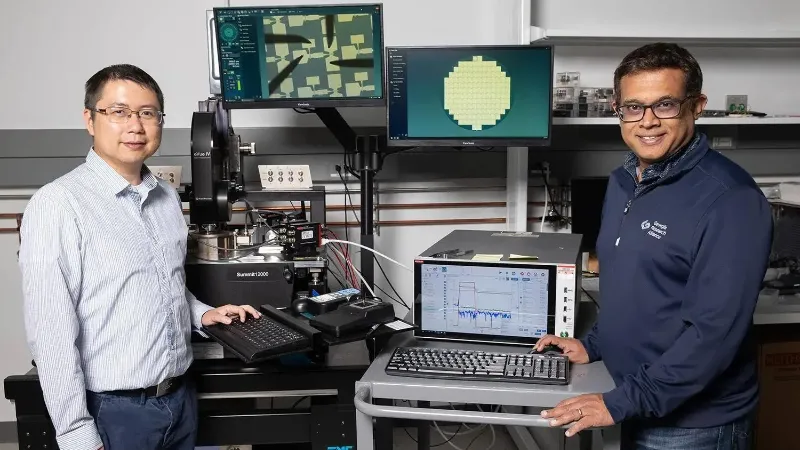
Nagare Labs, a semiconductor startup spun out of Georgia Tech, has emerged from stealth with $5 million in funding led by Playground Global to develop memory technology designed to improve the performance and efficiency of artificial intelligence (AI) systems.
The company is developing a new memory architecture called Z2RAM, which aims to address one of the biggest challenges in AI computing: the growing gap between processor speed and memory bandwidth.
As AI models become larger and more complex, processors need to access increasing amounts of data quickly. However, existing memory technologies often struggle to deliver data at the speed required, leading to delays, higher energy consumption and increased infrastructure costs.
“Memory performance has lagged behind logic performance scaling, creating the so-called memory wall for modern AI workloads,” said Dr. Suman Datta, Co-Founder of Nagare Labs. “We rethought the memory hardware stack so AI systems benefit from the access bandwidth and bit capacity they need to stay fluidic and responsive while consuming less energy and space.”
“Unlocking the full potential of next-generation AI requires fundamentally rethinking hardware from the memory layer up,” said Pat Gelsinger, General Partner, Playground Global. “Nagare Labs brings together world-class technical leadership and a brilliant architectural design that operates on existing fab infrastructure and is poised to define the next era of memory-centric computing.”
Nagare Labs aims to solve this problem by combining the speed of static random-access memory (SRAM) with the high storage density of dynamic random-access memory (DRAM). Its Z2RAM technology uses a transistor-based, capacitor-free design intended to deliver faster data access while reducing power consumption.
The company says its architecture could allow memory to be integrated in three-dimensional layers on top of logic chips. This approach could help improve data transfer speeds, reduce latency and make AI computing systems more energy-efficient.
Nagare Labs is also working on manufacturing scale-up. The technology is made to use standard semiconductor manufacturing processes and materials, which may reduce complexity and production cost. The firm says its architecture could support multiple layers of memory without requiring costly extreme ultraviolet (EUV) lithography for each layer.
Nagare Labs was co-founded by Dr. Suman Datta and Dr. Shimeng Yu, two semiconductor researchers and professors at Georgia Tech. Datta contributed to the development of Intel’s High-k/Metal Gate and Tri-gate transistor technologies, while Yu created NeuroSim, an open-source simulator used to study emerging memory technologies.
The startup aims to move its research from the laboratory toward commercially manufacturable memory chips for next-generation computing systems.
With the new funding, Nagare Labs is positioned to advance its memory technology as demand for faster, more efficient and scalable AI infrastructure continues to grow.