
Paris-based startup Bleu Robotics, which develops AI models for industrial humanoid robots, has raised €5 million in a pre-Seed funding round. The company aims to make the deployment of humanoid robots faster and easier, reducing the entire process to one hour or less.
The funding round was co-led by Contrarian Ventures and OVNI Capital, with participation from Kvanted, WEPA Ventures, Motier Ventures, Charlie Songhurst and board members at Meta.
Benoît Berkoukchi, co-founder of Bleu Robotics, says, “Humanoid robots in manufacturing are the next automotive sector, with the potential to help Europe and the US reshore production. But most robotics companies are trying to train humanoids with millions of data points and build fully general-purpose models. That approach isn’t suited to manufacturing. There isn’t enough data on factory work, and there won’t be internet-scale data, the kind LLMs were built on, for robots for a long time. Our methodology means we can do more with less.”
Thomas Poitrineau, Investor at Contrarian Ventures, adds, “We were attracted to Bleu Robotics because of their ambitious choice to rethink how humanoid robotics software should work from first principles. It’s rare to find a company led by two world-class robotics researchers and a manufacturing expert, which is also why their software works differently from their competition. Their goal is far bigger than simply making the best model in a lab. It’s an approach that can already scale, putting robots to work in factories within months rather than years.”
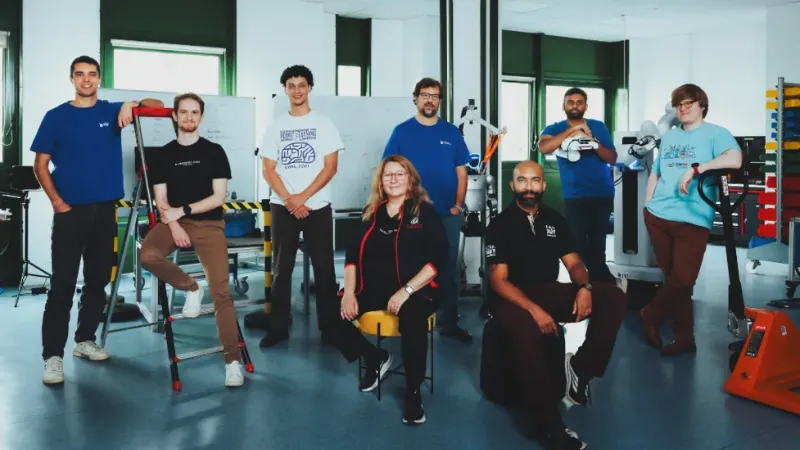
Founded in Paris in 2025, Bleu Robotics was started by two researchers from INRIA and a former Renault manufacturing manager. Its AI technology helps robots learn new tasks from just a few demonstrations by human operators.
The company’s software works with different humanoid robot platforms. It includes the AI models and training tools needed to teach robots new tasks directly on the factory floor.
According to the International Federation of Robotics, around 5 million industrial robots were operating worldwide in 2025. However, most of these robots are designed to perform the same tasks repeatedly and cannot easily adapt to changing production needs. As a result, many jobs that require flexibility are still handled by human workers.
Humanoid robots could help automate a wider range of complex tasks. Although robot hardware has improved significantly in recent years, software development has not kept up at the same pace. This has made it harder to bring humanoid robots into everyday industrial use.