
EDGE Sound Research, a company developing AI technology that helps machines understand the physical world through sound and sensor data, has raised an additional $2 million in an early-stage funding round led by Stormbreaker Ventures. The latest investment brings the company’s total funding to $9 million.
The company will use the new capital to expand deployments with live sports broadcasters, leagues, and venues. It will also develop its multimodal sensor data capabilities and build new applications for physical AI, robotics, autonomous systems, and intelligent environments.
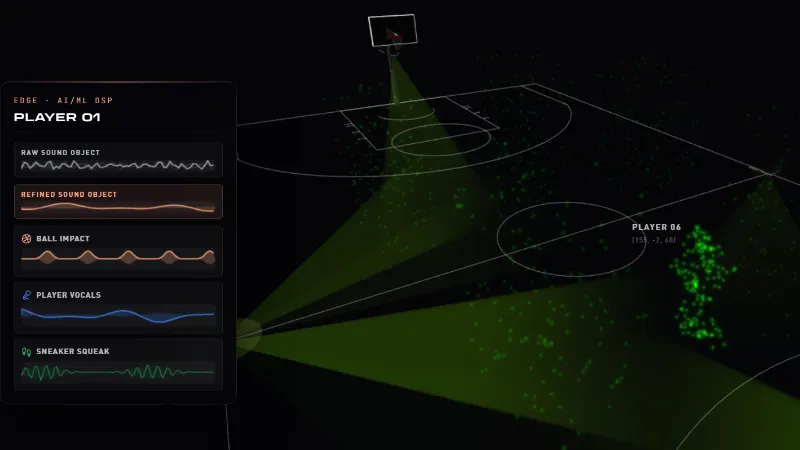
Founded in 2020, EDGE Sound Research develops technology that combines sound with video, tracking, timing, location, and other sensor data to help AI systems understand real-world environments. Its platform identifies individual sounds and events in noisy surroundings and connects them with other information to create a real-time picture of what is happening, where it is happening, and which objects are involved.
“Today’s robots and intelligent systems are like toddlers. They can reason at a high-level, but they don’t consider their full surroundings before making a decision,” said Valtteri Salomaki, co-founder and CEO of EDGE Sound Research. “Toddlers grow by combining what they hear, see and feel, then learning from what happens next. Machines don’t have that loop yet. We started with sound because it’s the signal most systems throw away, and solving it forced us to connect every other sensor in the room. A broadcaster following one player through a game and a robot knowing something happened behind it are the same problem.”
“Every conversation about physical AI runs into the same wall. The models and the robots are ready, but the underlying systems cannot reliably tell what is happening in real time,” said Said Mia, Founder and Managing Partner at Stormbreaker Ventures. “EDGE is building that perception layer, and building it with paying customers in one of the most acoustically hostile environments there is. The team spent years on how humans actually understand their surroundings, and they are turning that into the infrastructure physical AI desperately needs.”
The technology can help artificial intelligence systems learn about events that cameras alone might not pick up. For example, in live sports, it could help broadcasters automatically track the audio of an individual player during a game. The platform works with existing microphones, cameras and tracking systems, instead of requiring operators to replace their current equipment.
Live sports has been an important early market for the company, allowing it to test its technology in noisy and complex environments. EDGE Sound Research’s Virtual Sound Engine is already commercially deployed, with customers and partners including the NBA, Fox Sports, the United States Tennis Association, and Shure.
The company was founded by Valtteri Salomaki and Dr. Ethan Castro, whose research at the University of California, Riverside, helped shape its approach to sound-based perception. Their work combines research into how people perceive their surroundings through hearing and vibration with the use of sound as a source of data.
With its latest funding, EDGE Sound Research plans to expand beyond sports broadcasting and apply its technology to robotics, autonomous systems, and other AI-powered environments where machines need to interpret real-world activity in real time.