

Nvidia’s co-founder and CEO Jensen Huang has emerged as one of the world’s most influential people in the technology industry. His 2026 net worth is closely tied to Nvidia’s ascent as a major player in artificial intelligence (AI), data centers and advanced computing.
Nvidia’s growth has been a big part of shaping Huang’s personal fortune as companies spend billions of dollars on AI infrastructure.
But Huang’s fortune is more than his salary as CEO. His Nvidia shares, the long-term leadership and the fact that the company is at the center of the AI boom are key to his fortune.
Let’s talk about Jensen Huang’s net worth in 2026, his major income sources, his career journey, and how Nvidia helped him build one of the biggest fortunes in the tech sector in this article.
Jensen Huang Net Worth at a Glance
| Detail | Information |
|---|---|
| Estimated net worth | $185.6 billion |
| Net worth date | October 18, 2026 |
| Main source of wealth | Nvidia shares |
| Company | Nvidia |
| Role | Co-founder, president and CEO |
| Industry | Semiconductors and AI computing |
| Company founded | 1993 |
| Nvidia IPO | 1999 |
*Net worth is an estimate and changes with stock prices. Figures can differ between wealth trackers and calculation dates.
How Did Jensen Huang Build His Fortune?
Jensen Huang didn’t get rich by just making a lot of money. The bulk of his fortune is tied up in his stake in Nvidia.
In 1993 Huang, along with Chris Malachowsky and Curtis Priem, co-founded Nvidia. The company initially developed graphics processing technology for computers and video games.
Later Nvidia developed graphics processing units, or GPUs, that turned out to be useful for more than just gaming. Researchers found that GPUs could do lots of calculations at once, which made them useful for things like scientific computing and artificial intelligence.
That technology has formed the basis of modern AI development.
As demand for the company’s chips grew, so did its business and stock-market value. Huang’s stake was worth more, making him one of the world’s richest technology executives.
Read Also – Elon Musk Net Worth 2026: How He Built His Fortune
How much Nvidia stock does CEO Jensen Huang actually own?
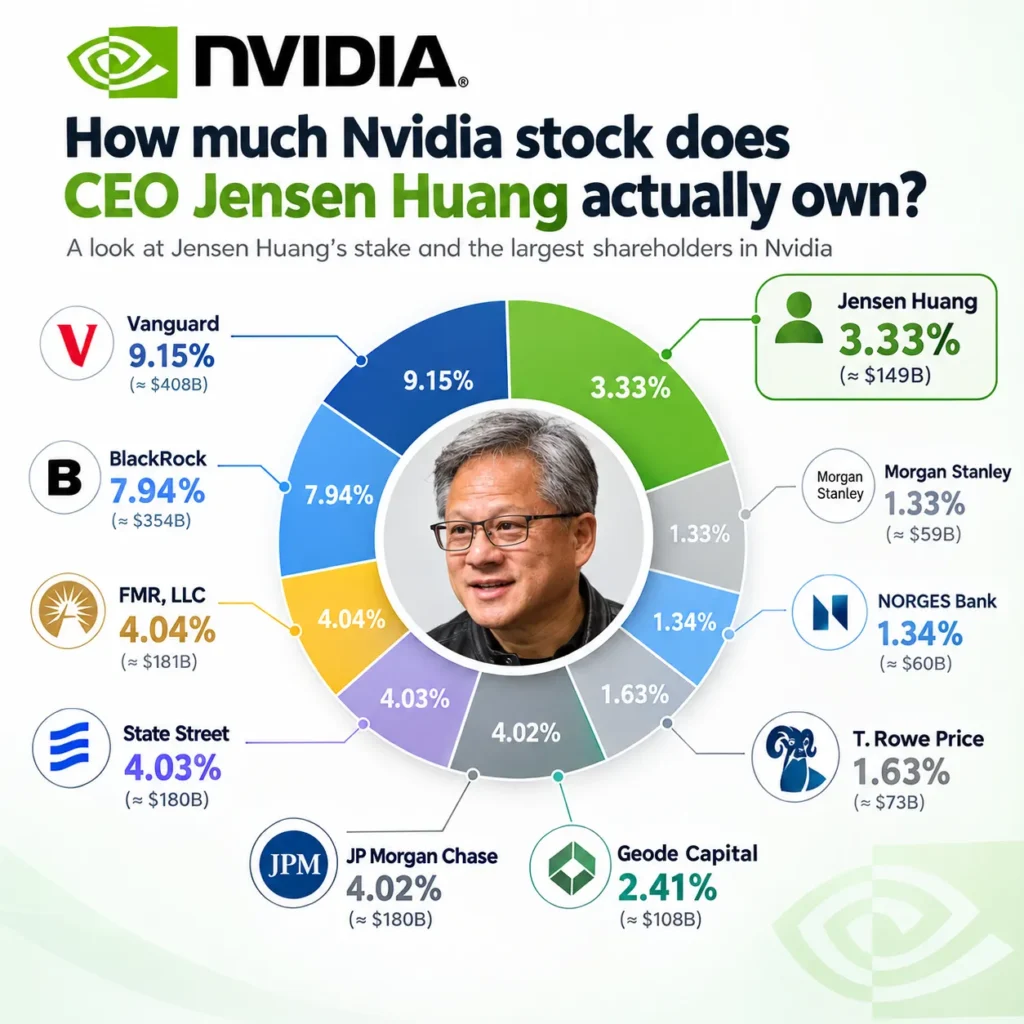
Nvidia CEO Jensen Huang owned approximately 870 million shares, representing a 3.58% stake in the company, as of March 23, 2026. His shares were worth around $201 billion at an early October 2026 stock price of $231.49. Huang’s fortune mainly comes from his Nvidia holdings, which have grown in value as demand for AI chips has surged.
Nvidia’s shareholders include major investment firms, institutional investors, and company executives. While Jensen Huang is the largest known individual shareholder, firms such as BlackRock and Vanguard hold larger stakes in the company through their investment funds.
According to Nvidia’s 2026 proxy statement, the company’s largest disclosed shareholders as of March 2026 included BlackRock, with a 7.43% stake, and Vanguard Capital Management, with 7.31%. Other major shareholders include State Street, Fidelity (FMR LLC), and Geode Capital Management.
Jensen Huang Wealth Timeline: From Startup Founder to Billionaire
1993: Nvidia Begins as a Startup
Huang co-founded Nvidia in 1993 with two fellow engineers. The company entered a competitive semiconductor market, where developing new chips required significant research, engineering and investment.
At the time, there was no guarantee that Nvidia would become a major technology company. Its early business focused on computer graphics, particularly the growing market for 3D graphics and gaming.
The founders were betting that more powerful graphics technology would become increasingly important.
1999: Nvidia Goes Public
Nvidia went public in 1999, giving investors access to its shares through the stock market.
The IPO marked an important step in the company’s growth. It helped Nvidia expand its business and gave the market a way to value the company.
For Huang, holding a stake in Nvidia created the opportunity to build long-term wealth as the business expanded.
2000s: Nvidia Expands Beyond Gaming
Nvidia continued developing graphics processors for gaming and professional computing.
Over time, its technology became useful for a wider range of applications. GPUs could process many operations at once, making them valuable for workloads that required large amounts of computing power.
This created opportunities beyond the gaming market.
Rather than remaining focused on one product category, Nvidia invested in technologies that could support other types of computing.
2010s: AI Creates a New Business Opportunity
During the 2010s, artificial intelligence research began creating more demand for powerful computing systems.
Nvidia’s GPUs proved useful for training deep-learning models. The company also developed software tools and a broader computing platform to help developers use its hardware.
This was an important business shift. Nvidia was no longer competing only in graphics chips; it was becoming a supplier of technology for AI research and development.
As AI adoption grew, Nvidia gained access to a much larger market.
2020–2023: The AI Boom Accelerates
Demand for AI computing increased as businesses developed large language models, generative AI products and cloud-based AI services.
Technology companies needed more GPUs to train and run their models. Nvidia benefited from this demand through its chips, networking products and data-center systems.
The growth in its business helped lift its stock-market value and Huang’s personal fortune.
Nvidia reached a $1 trillion market valuation in 2023, reflecting investor expectations for its role in the expanding AI industry.
2024–2025: Nvidia Becomes Central to AI Infrastructure
Nvidia’s role in AI expanded as major technology companies and AI startups invested in data centers.
Its business increasingly covered complete AI computing systems, including GPUs, networking and software.
The company became an important supplier to businesses building and operating AI models. This helped strengthen the connection between global AI investment and Nvidia’s financial performance.
By 2025, Nvidia had reached a market valuation of more than $5 trillion, according to Forbes’ profile of Huang. His wealth rose sharply as the company’s shares increased.
2026: Huang’s Fortune Moves Above $200 Billion, Then Falls
In October 2026, Huang’s estimated fortune passed $200 billion after Nvidia shares reached a record high. Forbes estimated his net worth at $204.5 billion on October 2.
However, his wealth later fell below that level as technology shares declined. Forbes’ real-time ranking put his fortune at approximately $185.6 billion on October 18. Sources: Forbes Real-Time Billionaires.
The change illustrates a key point about billionaire wealth: a founder’s estimated net worth can rise or fall by billions of dollars even without a comparable change in personal cash holdings.
Read Also – Top 10 Richest People in the World in 2026: Net Worth and Rankings
Nvidia Forecasts Strong Future Revenue Growth
In August 2026, Nvidia forecast that its revenue could grow by 70% in the next fiscal year, ending January 2028. The company also forecast $108 billion in revenue for the following quarter.
Reuters reported that Nvidia’s second-quarter revenue reached $96.22 billion, more than double the figure from a year earlier. Demand for AI computing was a major driver.
Nvidia also announced an expanded partnership with Amazon Web Services to deploy an additional two million Nvidia GPUs across Amazon’s global infrastructure in 2027 and 2028.
For Huang, continued business growth can support Nvidia’s share price and the value of his holdings. However, forecasts are not guarantees, and investors will continue to watch revenue, costs and profit margins.
Nvidia Sees a Trillion-Dollar AI Chip Opportunity
At Nvidia’s GTC conference in March 2026, Huang said the company saw at least $1 trillion in potential demand for its Blackwell and Vera Rubin computing platforms through 2027.
The statement reflects Nvidia’s view that demand for AI computing is expanding beyond training large models. Companies also need computing capacity to run AI systems and deliver services to customers.
For startups, this creates opportunities in AI software, data infrastructure, developer tools and specialized applications. It also means access to computing power and the cost of running AI products are increasingly important business considerations.
Read Also – Charlie Kirk Net Worth: How Much Was He Worth When He Died?
What Jensen Huang’s Fortune Means for Startups
Huangs success offers a business lesson: a company can build a large market by solving a difficult technical problem before demand reaches its full potential.
Nvidia started in computer graphics. Its investment in GPUs, developer software and accelerated computing later positioned it to serve the AI industry.
That strategy has helped create opportunities for businesses too. AI startups need chips and cloud infrastructure while enterprise customers need software that can turn AI capabilities into products.
At the time Nvidias position shows the risks of depending on a small number of infrastructure suppliers. AI companies must consider computing costs, access, to hardware, performance and whether their business models can generate revenue to cover those expenses.
Huangs wealth is therefore not a personal financial story. It reflects the growing importance of the infrastructure powering artificial intelligence.
Final Takeaway
Jensen Huangs estimated fortune of $185.6 billion is closely linked to Nvidias journey. Nvidia began as a graphics-chip startup and has become a main supplier of AI computing infrastructure.
Jensen Huangs wealth timeline shows the value of long‑term technology investment. Nvidia built its business around GPUs years before AI demand reached the scale it has today.
Now the companys growth prospects, competition and ability to meet demand will influence both Nvidias business future and Jensen Huangs personal fortune.
For founders and business leaders the key lesson is that major opportunities can emerge when technology created for one market becomes essential, to another.
Forbes’ real-time billionaire ranking estimated Huang’s net worth at approximately $185.6 billion on October 18, 2026. The figure changes with Nvidia’s share price and may differ across wealth trackers.
Huang built his fortune primarily through Nvidia, which he co-founded in 1993. The company grew from a graphics-chip business into a major supplier of AI computing technology.
Nvidia’s 2026 proxy statement showed that Huang beneficially owned about 870 million shares, or approximately 3.58% of the company, as of March 23, 2026.
His estimated wealth increased when Nvidia shares reached new highs, reflecting investor expectations for continued AI-related growth. His fortune later declined as the stock fell.
AI has played a major role in Nvidia’s recent growth, but Huang’s wealth is rooted in a company he co-founded in 1993. Nvidia spent years developing graphics processors and computing technology before the current AI boom.
Net worth data last checked: October 18, 2026.