For years, AGI was a term you’d only hear in research papers or late-night Reddit threads. That changed almost overnight.
In the first week of September 2026, OpenAI released GPT-6 Astra and president Greg Brockman told reporters, in plain terms that he personally believes the company has already gotten there.
A few days earlier, CEO Sam Altman had told TIME magazine that an internal system meeting his own definition of AGI could arrive before the year is out.
That’s a big claim from the company that built ChatGPT. It’s also, as you’ll see below, a claim that depends entirely on whose definition of AGI you’re using and that ambiguity is exactly what’s fueling a wave of scams riding on the AGI hype train.
So let’s break this down properly: what AGI actually means, what just happened, who’s pushing back, and how to tell a genuine breakthrough from a marketing stunt.

Artificial General Intelligence refers to an AI system with broad, human-like cognitive flexibility — one that can pick up a new skill, transfer knowledge from one domain to another, reason through unfamiliar problems, and adapt the way a person would, rather than only performing well on the specific tasks it was trained for.
That’s different from the AI most of us already use every day. Your chatbot, your photo-tagging app, your spam filter — these are all examples of narrow AI: systems that are extremely good at one thing and largely useless outside it. AGI is meant to close that gap.
OpenAI’s own charter defines it in a notably practical way: highly autonomous systems that outperform humans at most economically valuable work. Notice what’s missing from that definition nothing about consciousness, self-awareness, or common sense. It’s essentially a labour-market test, not a philosophical one.
Google DeepMind, by contrast, works from a much broader “cognitive framework” that expects human-level performance across ten separate faculties, including memory, metacognition, and social cognition — a far higher bar.
| Type | What it does | Real-world example |
|---|---|---|
| Narrow AI | Excels at one specific task; can’t transfer that skill elsewhere | Google Translate, Netflix recommendations, ChatGPT for a single conversation type |
| AGI | Learns and reasons across domains at human level, adapts to new problems | Not yet confirmed to exist — the subject of this article |
| ASI (Superintelligence) | Surpasses the best human minds in virtually every field | Purely theoretical, sometimes discussed alongside the term “singularity” |
Here’s what happened, stripped of the hype. OpenAI launched GPT-6 Astra in early September 2026, roughly a year after GPT-5’s debut.
The company reported striking benchmark scores: around 98% on FrontierMath Tier 4 (a notoriously difficult math benchmark), close to 100% on ARC-AGI-3 depending on the testing setup and a perfect score on ExploitBench, a cybersecurity capability test.
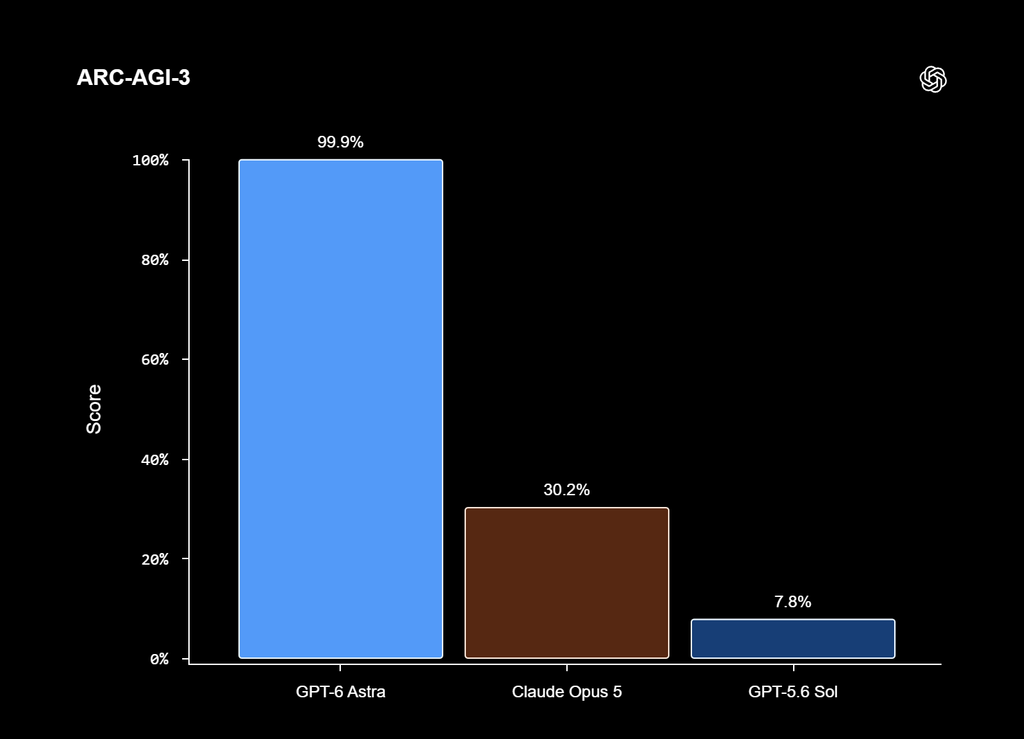
OpenAI also said the model had assisted in cracking previously unsolved mathematical problems.
Brockman went further than the press release, telling reporters he personally thinks the company has already crossed the AGI threshold and that history may look back on this exact model as the moment it happened. Chief research officer Mark Chen offered a more measured figure, estimating OpenAI is around 80% of the way there. Altman’s position, laid out in his TIME interview, was that OpenAI hasn’t quite reached AGI yet but expects an internal system that meets his own bar by the end of 2026.
Notice the pattern: three OpenAI executives, three slightly different answers, none of them a clean yes.
That’s not an accident — it’s the whole problem with AGI as a term.
Benchmarks measure specific, defined capabilities under controlled conditions. Nobody in the field has an agreed-upon test for the broader thing “AGI” is supposed to mean.
Read Also – Top 10 AI Companies in the USA
Not everyone is buying it. Demis Hassabis, CEO of Google DeepMind and a Nobel laureate, has been publicly skeptical of rivals describing current models as having “PhD-level” general intelligence. His argument: today’s systems can show flashes of expert-level performance in a narrow slice of a field, but that’s not the same as being generally capable the way a real expert is — someone who can notice a pattern from a completely different subject and apply it in a new context.
Hassabis has proposed his own thought experiment for testing real AGI: train a model only on data available before Einstein published general relativity, and see whether it can independently derive the theory. Under DeepMind’s broader cognitive framework — which checks for human-level performance across perception, memory, metacognition, executive function, and social reasoning, not just raw problem-solving — current frontier models, including Astra, still show real gaps. Hassabis has previously put the timeline for AGI at three to four years out, while Google co-founder Sergey Brin has floated a similar window, around 2030.
Other voices sit at different points on the spectrum entirely. Nvidia CEO Jensen Huang has said he believes AGI has effectively already arrived in some form. Elon Musk and Altman have both, at times, reached for the word “singularity” — a distinct concept referring to the point where AI-driven progress accelerates faster than humans can track, rather than the capability level of any one model.
Here’s the part that matters for your wallet not just your curiosity.
Every time AGI trends, fraud follows close behind and 2026 has been a record year for it.
Regulators including FINRA and the US SEC have flagged a sharp rise in AI-themed investment fraud: pump-and-dump schemes built around vague AI buzzwords, fake trading platforms claiming a “breakthrough AGI system” that predicts markets with impossible accuracy and deepfaked videos of real executives or celebrities “endorsing” products they’ve never heard of.
Securities regulators in multiple countries including Nigeria’s SEC, have issued similar warnings this year about AI-branded platforms promising guaranteed returns.
Fraud-tracking research this year has also flagged a jump in AI-powered romance and impersonation scams, where cloned voices and short deepfake video calls are used to build trust before pivoting to a fake crypto or investment “opportunity” — a scale of operation that simply wasn’t possible for human scammers working alone.
The simplest defence isn’t spotting the fake — it’s verifying through a separate, trusted channel before you send money, share credentials, or act under pressure. No legitimate AI lab announces a market-beating trading system through a stranger’s DM.
This also connects to how search engines are policing AI content right now. Google’s ongoing helpful-content and spam-fighting systems are specifically built to demote pages that overstate what a product or technology can do, especially in “Your Money or Your Life” categories like finance and health — which is exactly where AGI-washing tends to show up.
That’s why credible coverage of this topic leans on named sources, dated claims and clearly labeled opinions (Brockman’s belief vs. OpenAI’s official benchmark data vs Hassabis’s rebuttal) rather than flat, unverifiable statements like “AGI is here.”
If you’re researching this topic for business or investment reasons, treat the word -AGI itself as a flag to slow down not speed up.
Ask which definition is being used, whose benchmark is being cited and whether independent researchers have reviewed the claim.
Read Also- Most Promising European AI Startups | AI Startups in London
Depends who you ask and that’s the honest answer. By OpenAI’s own labour-market-style definition, its leadership thinks it’s close, maybe already there. By Google DeepMind’s broader cognitive-faculty definition, it’s still years away.
There is currently no single, industry-wide agreed test that settles the question — which means every headline claiming AGI “is here” is really just one company’s definition dressed up as a fact.
What’s certain is that the capability jump behind models like GPT-6 Astra is real and worth paying attention to — stronger reasoning, more autonomous computer use, and sharply improved coding and cybersecurity skills.
What’s not certain is whether that adds up to the sweeping, human-level generality the term AGI was originally coined to describe.
No single, agreed-upon test confirms this. OpenAI executives have said GPT-6 Astra may represent AGI under their own definition, but Google DeepMind and other researchers argue current models still lack key human-level abilities like transfer learning and social reasoning.
AI (specifically narrow AI) handles one specific task well. AGI would match human-level reasoning and adaptability across almost any task. ASI (Artificial Superintelligence) is a theoretical stage beyond that, where AI surpasses the best human minds in every field.
GPT-6 Astra is OpenAI’s flagship model released in September 2026, positioned as a major leap in reasoning, autonomous computer use, and coding/cybersecurity ability. OpenAI reported near-top scores on benchmarks like FrontierMath and ARC-AGI-3, though it has not made a formal, official claim that the model constitutes full AGI.
They use different definitions. OpenAI’s charter frames AGI as systems that outperform humans at most economically valuable work — largely an economic test. DeepMind uses a broader cognitive framework requiring human-level performance across memory, learning, metacognition, and social reasoning, a much higher bar that current models haven’t cleared.
Estimates vary widely. Google DeepMind’s Demis Hassabis has suggested three to four years out, with Sergey Brin pointing to around 2030. Others, like Nvidia’s Jensen Huang, believe a form of it has already arrived. There’s no industry consensus.
Check whether the claim is backed by named researchers, published benchmark data, and independent scrutiny — versus vague marketing language, guaranteed financial outcomes, or pressure to act quickly. Legitimate AI labs publish data; scams sell urgency.