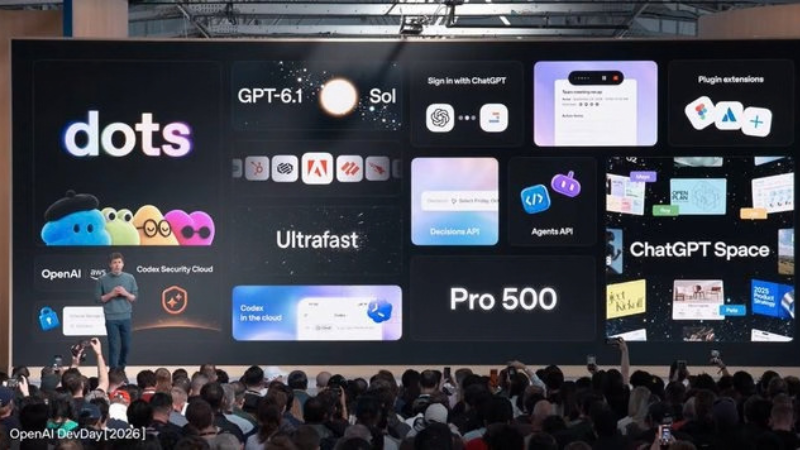
OpenAI announced more than 20 new products and features at its DevDay 2026 event on September 29. The announcements cover ChatGPT, AI models, Codex, developer APIs and new ways for people to work with AI.
Among the major announcements were Dots, a new type of always-on AI agent, GPT-6.1 Sol, ChatGPT Space, cloud-based Codex and new tools for developers.
OpenAI introduced Dots, AI agents designed to keep working on tasks after the initial instruction. Dots can use connected tools and services and continue working toward a goal without requiring users to give instructions at every step.
OpenAI says Dots can handle ongoing and recurring tasks and can work across connected services. Users can also set rules and permissions for how a Dot can act.
Dots are currently available to Pro and Business Premium users in eligible markets. Enterprise, Education and Healthcare users can access a beta when enabled by their workspace administrator.
OpenAI also introduced GPT-6.1 Sol, a new model in the GPT-6 family. The company says it offers performance close to GPT-6 Astra for coding, computer use and professional work, while using fewer resources.
The model has a 1.05 million-token context window and supports up to 128,000 output tokens. It is available through the API and for Plus, Pro, Business, Enterprise and Education users.
OpenAI has also introduced Ultrafast, a premium speed tier for workloads where faster responses are important. GPT-6 Astra Ultrafast is available in the API and in ChatGPT Work and Codex for Pro 500 and Enterprise plans.
OpenAI announced ChatGPT Space, a shared workspace where teams can work with ChatGPT and Dots on common projects.
Teams can share knowledge, pages and other project materials, while ChatGPT can help organize information based on instructions.
OpenAI also introduced Pages, which allow people and AI agents to work together on documents. Users can write, research, create charts, generate images and organize information on a shared page.
OpenAI is expanding Codex with cloud-based development environments. Developers can now run coding tasks from a computer, phone or other device, while tasks can continue running in the cloud.
Each environment can include the project’s repositories, tools and dependencies. This allows developers to continue working on tasks even when their computer is not running.
OpenAI also introduced Codex Security Cloud, which can scan GitHub repositories, investigate security issues and prepare fixes in the cloud.
OpenAI announced new developer tools for building AI agents that can interact with software and make decisions.
The Agents API now supports computer use, allowing developers to build agents that can operate software to complete tasks. It also includes multi-agent capabilities, tool search, tool calling and context compaction.
The company also introduced the Decisions API, which helps applications choose from a defined set of answers. OpenAI says it can be used for tasks such as classification, routing and selecting an agent’s next action. The API is currently in limited preview.
OpenAI also launched ChatGPT Pro 500, a $500-per-month plan with higher usage limits and access to Astra Ultrafast.
The plan is available through ChatGPT on the web. OpenAI says Astra Ultrafast is included with Pro 500, while users on lower Pro plans can purchase additional credits but do not get access to Astra Ultrafast.
Overall, the DevDay 2026 announcements expand OpenAI’s focus from chat-based AI toward agents, cloud-based development, team collaboration and AI-powered software tools.