

Turn on any business news channel and you’ll hear the word within minutes: Nasdaq. It’s shorthand for tech stocks surging, tech stocks tanking, and pretty much everything in between.
But most people who use the term daily couldn’t tell you what Nasdaq actually is, how it’s different from the New York Stock Exchange or why a company would choose to list there instead of anywhere else. This guide breaks it down in plain language — what Nasdaq is, how it works, and what it means for anyone looking to understand or invest in the market.
What Is Nasdaq?
Nasdaq stands for the National Association of Securities Dealers Automated Quotations. That’s a mouthful, so almost nobody uses the full name but it explains a lot about what makes the exchange different. When it launched in 1971, Nasdaq became the world’s first electronic stock exchange, built to automate stock quotes at a time when trading floors, hand signals, and paper tickets still ran the show.
The word “Nasdaq” now does double duty. It refers to the stock exchange itself, where thousands of companies list and trade their shares, and it also refers to a family of market indexes — most notably the Nasdaq Composite and the Nasdaq-100 — that track how those listed companies are performing as a group.
When someone says “the Nasdaq was up today,” they’re usually talking about one of these indexes, not the exchange’s operations.
History
From Outsider Exchange to Tech Powerhouse
Nasdaq didn’t start out as the tech heavy exchange it’s known as today. In its early decades, it built a reputation as the home for younger, faster-growing companies that didn’t yet meet the stricter listing requirements of older exchanges like the NYSE.
That reputation turned out to be a magnet for technology companies. Names like Apple and Microsoft listed on Nasdaq in their growth years, and as the personal computing and internet booms took off through the 1980s and 1990s, more tech firms followed.
That concentration of growth-stage tech companies is exactly what fueled the dot-com boom — and the dot-com bust that followed it in the early 2000s. Nasdaq’s identity as a barometer for innovation and risk appetite was cemented during that period, and it has largely stuck ever since. Today it’s home to a wide mix of industries beyond tech, including biotech, finance, healthcare, and consumer companies, but the “tech exchange” reputation remains its defining trait.
How Nasdaq Actually Works

Unlike the NYSE, which still operates a physical trading floor in Lower Manhattan, Nasdaq has no trading floor at all. Every trade happens electronically, routed through a network of computers rather than human specialists shouting orders across a room. That’s what “automated quotations” in the name actually refers to.
Nasdaq operates as a dealer market which means trades don’t happen through a direct auction between buyer and seller.
Instead, licensed market makers — firms that hold inventories of specific stocks — stand ready to buy or sell shares at quoted prices, providing the liquidity that keeps trading smooth even when buyers and sellers aren’t perfectly matched at any given moment. Multiple market makers typically compete on the same stock which helps keep spreads competitive.
Trading on Nasdaq happens across three windows, all in U.S. Eastern Time:
Pre-market: roughly 4:00 am to 9:30 am
Regular session: 9:30 am to 4:00 pm
After-hours: 4:00 pm to 8:00 pm
Pre-market and after hours sessions typically see lower trading volume and wider price swings, since fewer participants are active — something worth knowing before placing trades outside regular hours.
Read More : Venture Capital Firms | Top 10 AI Companies in the USA
The Nasdaq Indexes: What They Track
The two indexes most people mean when they say “the Nasdaq” are:
Nasdaq Composite
Tracks nearly every stock listed on the exchange — thousands of companies across every sector, weighted by market capitalization. It’s the broadest snapshot of Nasdaq’s overall health.
Nasdaq-100
A narrower index of the 100 largest non-financial companies listed on Nasdaq. Because it excludes banks and other financial firms, it skews even more heavily toward technology, communications, and consumer-facing growth companies. This is the index tracked by popular ETFs like Invesco QQQ.
Neither index can be bought directly. Investors gain exposure to them through index funds, ETFs, or mutual funds designed to mirror their performance or by buying shares of individual companies listed on the exchange.
Nasdaq vs NYSE: The Real Differences
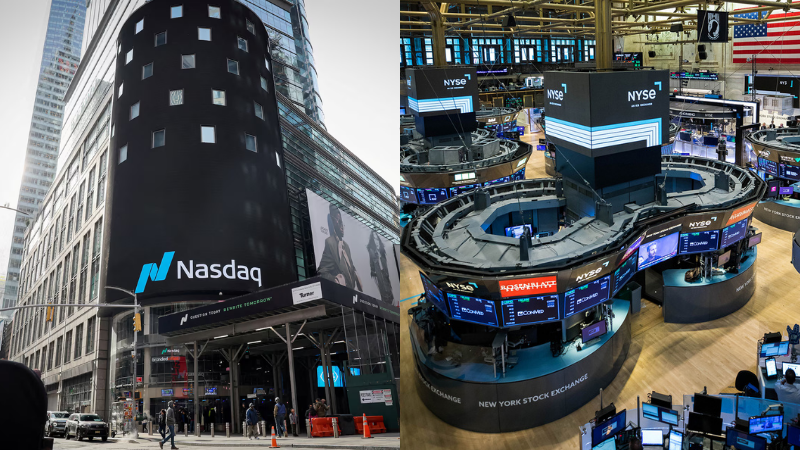
The two exchanges get compared constantly and the differences go beyond “one has a trading floor and one doesn’t.” A few that actually matter:
Listing standards
Nasdaq’s requirements have historically been more accessible for younger, high-growth companies, while the NYSE has leaned toward larger, more established firms — though both exchanges today host companies across the size spectrum.
Listing costs
Listing on Nasdaq is generally less expensive than listing on the NYSE which is part of why it remains attractive to newer companies.
Market structure
Nasdaq is a dealer market built on market makers; the NYSE uses a hybrid model that still involves designated market makers on a physical floor.
Sector concentration
Nasdaq skews toward technology and growth stocks. The NYSE has a broader mix, with a heavier presence of industrial, financial, and blue-chip names.
Neither structure is objectively “better” — they simply serve different types of companies and, to some extent, different investor expectations around volatility and growth potential.
What It Takes for a Company to List on Nasdaq
Getting listed isn’t automatic. Companies need to clear a set of financial, liquidity, and governance requirements set by the exchange, and register with the U.S. Securities and Exchange Commission. Nasdaq offers several listing tiers with different financial standards which is part of why it can accommodate everything from early-stage growth companies to some of the largest corporations in the world on the same exchange.
Requirements generally cover minimum share price, market value, number of publicly held shares, number of market makers committed to the stock, and corporate governance standards like having independent board members.
Why Nasdaq Matters to Everyday Investors
Even investors who never buy an individual tech stock are usually exposed to Nasdaq in some way — through a retirement account, an index fund, or an ETF that tracks the Nasdaq-100 or Composite. Because the exchange is so concentrated in technology and innovation-driven companies, its performance tends to move faster and further than broader benchmarks like the S&P 500, in both directions. That makes it a useful — if occasionally nerve-wracking — signal for how investors feel about growth, risk, and the tech sector’s prospects at any given moment.
For investors specifically interested in this space, the entry points are straightforward first buy individual shares of Nasdaq-listed companies through a brokerage account or gain diversified exposure through an ETF or mutual fund built around one of Nasdaq’s indexes.
As with any investment decision, exposure to a tech heavy index comes with tech-heavy volatility so it’s worth weighing against personal risk tolerance and time horizon rather than chasing performance after the fact.
National Association of Securities Dealers Automated Quotations. It launched in 1971 as the world’s first electronic stock exchange.
No. Nasdaq is the exchange itself. The Nasdaq Composite is one of several indexes that track the performance of companies listed on that exchange.
Not directly. You can invest in companies listed on Nasdaq, or in ETFs and mutual funds designed to track indexes like the Nasdaq-100 or Nasdaq Composite.
Nasdaq is a fully electronic dealer market with no trading floor and a heavier concentration of technology and growth companies. The NYSE uses a hybrid model with a physical trading floor and a broader mix of industries, including more established, blue-chip firms.
Pre-market runs roughly 4:00 a.m. to 9:30 a.m. ET, the regular session runs 9:30 a.m. to 4:00 p.m. ET, and after-hours trading runs 4:00 p.m. to 8:00 p.m. ET.