Torus, a U.S.-based manufacturer of distributed power and computing infrastructure, has launched Foundry, a modular AI infrastructure platform designed to meet growing demand for AI inference computing. The company also announced $500 million in growth capital led by Magnetar, with participation from ICONIQ, Origin Ventures, Ridgeline Partners and Trinity Capital.
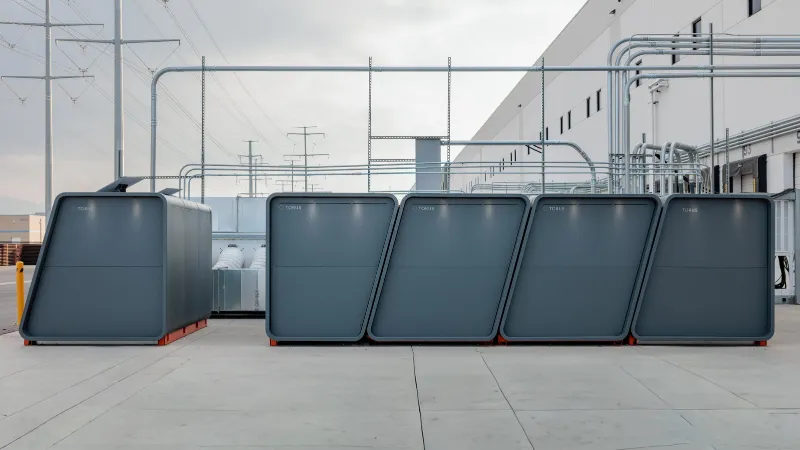
Foundry combines power, storage, cooling, networking and computing hardware in prefabricated modular systems. The platform is designed to bring new AI computing capacity to existing commercial and industrial sites within 12 to 16 weeks, compared with the years often required to develop traditional hyperscale data centre campuses.
Torus plans to use the new capital to expand its manufacturing operations and accelerate deployments of Torus Foundry and its energy storage platform, Torus Reserve, across the United States.
Torus Targets Growing Demand for AI Inference
AI infrastructure demand is increasingly moving beyond model training toward inference, where trained AI models respond to user requests and run applications in real time.
According to McKinsey, demand for AI inference computing in data centres is projected to grow by 35% annually through 2030, compared with 22% for AI training.
Inference workloads often need continuous computing capacity closer to users and businesses. This is increasing interest in distributed data centres and on-premises infrastructure, where enterprises can maintain greater control over security, intellectual property and workload locations.
Torus designed Foundry to address this demand by deploying computing capacity at existing sites with available electricity, rather than depending entirely on new data centre construction and grid connections.
Foundry Combines AI Computing with Energy Storage
A central part of Torus’s approach is addressing power availability. The company believes that unused capacity across existing electricity connections can help support AI infrastructure without always requiring new generation or major grid upgrades.
Each Foundry deployment is paired with Torus Reserve, the company’s energy storage and management system. Reserve combines battery storage, inertial flywheel technology and power management capabilities to help manage electricity demand.
Its features include load curtailment, grid flexibility, ramp-rate support and backup power during grid outages. These capabilities are designed to manage sudden changes in computing demand and support more stable power delivery.
By managing demand peaks, Torus aims to fit more computing capacity within an existing electricity connection. The company says its systems can use available capacity at individual transformers without requiring the infrastructure upgrades that can add costs and affect electricity rates.
Modular AI Infrastructure Designed for Faster Deployment
Foundry is designed as a prefabricated system that can be installed at existing sites without constructing a traditional data centre building.
Key features include:
- Deployment in 12–16 weeks: Torus targets this timeframe from contract to operational AI workloads.
- Modular capacity: Each site can support between 1 MW and 20 MW of IT load.
- Prefabricated systems: Units are manufactured before arriving at the deployment site, reducing construction work.
- Integrated infrastructure: Torus provides power, cooling, networking, storage and computing through one platform.
- Existing grid connections: Systems are designed to use available electricity capacity at existing sites.
- Ongoing operations: Torus provides maintenance and operational support after installation.
The company says site preparation takes approximately one week, while installation and commissioning take one to two days.
Foundry is available through three deployment models:
- Strategic: A powered shell that includes the power infrastructure and enclosure but does not include GPUs.
- Partner: A turnkey bare-metal system that includes power, enclosure and GPUs for infrastructure partners.
- Direct: Dedicated inference capacity supplied directly to enterprise customers, with single-tenant hardware allocated exclusively to their workloads.
Torus has launched Foundry with its first customers, including Hydra Host and another AI cloud provider.
The company says thousands of GPUs are already deployed through its infrastructure, with plans to exceed 47,000 GPUs in Foundry units by the end of 2027.
$500 Million to Expand U.S. Manufacturing and Deployments
The $500 million growth capital round was led by Magnetar. Other participants included ICONIQ, Origin Ventures, Ridgeline Partners and Trinity Capital.
The funding will support the expansion of GigaOne, Torus’s manufacturing facility in Salt Lake City, Utah, and accelerate deployments of its energy storage and AI infrastructure products across the country.
GigaOne covers 545,000 square feet and is responsible for designing, engineering and manufacturing Foundry systems. The facility opened its first production line in early 2026, with the company reporting that it has added a new production line every 21 days during the year.
The Foundry production line is operational and is expected to support up to 500 MW of IT load capacity, with plans to expand to 1 GW.
Torus employs nearly 400 people and manufactures key components in-house at the Utah facility.
Water-Efficient Cooling and Environmental Initiatives
Torus says Foundry uses a closed-loop cooling system that does not rely on water evaporation. According to the company, this approach uses 95% less water than evaporative cooling systems.
The platform is also designed to make use of existing grid capacity, potentially reducing the need for new transmission infrastructure and electricity generation associated with some large data centre developments.
In addition, each Foundry system contributes GPU computing time to medical research through Folding@home.
Torus Expands Its Distributed Energy and AI Infrastructure Business
Headquartered in Salt Lake City, Torus develops distributed energy storage, power management and modular AI computing infrastructure.
Its technology combines battery and inertial-based storage, AI-powered energy management, cybersecurity, computing systems and ongoing operations. The company serves utilities, data centres, manufacturers and commercial and industrial facilities.
With Foundry, Torus is expanding its business beyond energy storage into modular AI infrastructure, targeting enterprises and AI cloud providers that need computing capacity faster and closer to where their workloads run.