
The US defence startup sector is attracting billions of dollars as companies develop new technologies across autonomous systems, artificial intelligence, aerospace, cybersecurity, space, hypersonic systems, robotics and advanced energy.
The growing interest in defence technology is also taking place against the backdrop of significant US military spending. According to the Stockholm International Peace Research Institute (SIPRI), the United States remained the world’s largest military spender in 2025, accounting for about 33% of global military expenditure. US military expenditure reached an estimated $954 billion in 2025, around 2.8 times China’s military spending.
The US government’s FY2026 National Defense Budget Request further highlights the scale of the market. The request included approximately $1.01 trillion for national defense including $848.3 billion in Department of Defense discretionary funding and additional reconciliation funding.
Technology is a major focus of this spending. The FY2026 request included $142 billion for Research, Development, Test and Evaluation (RDT&E) while the Department of Defense highlighted investments in autonomy, hypersonic weapons, missile defense, space capabilities, cybersecurity and advanced military systems. The request specifically identified $13.4 billion for autonomy and autonomous systems, including unmanned aerial, ground and maritime capabilities.
This combination of government spending, military modernization and private investment is creating opportunities for a new generation of defence technology companies. Startups are developing systems designed to support military operations across air, land, sea, space and digital environments, often combining software, artificial intelligence and advanced hardware.
US Defence Industry: Market Overview
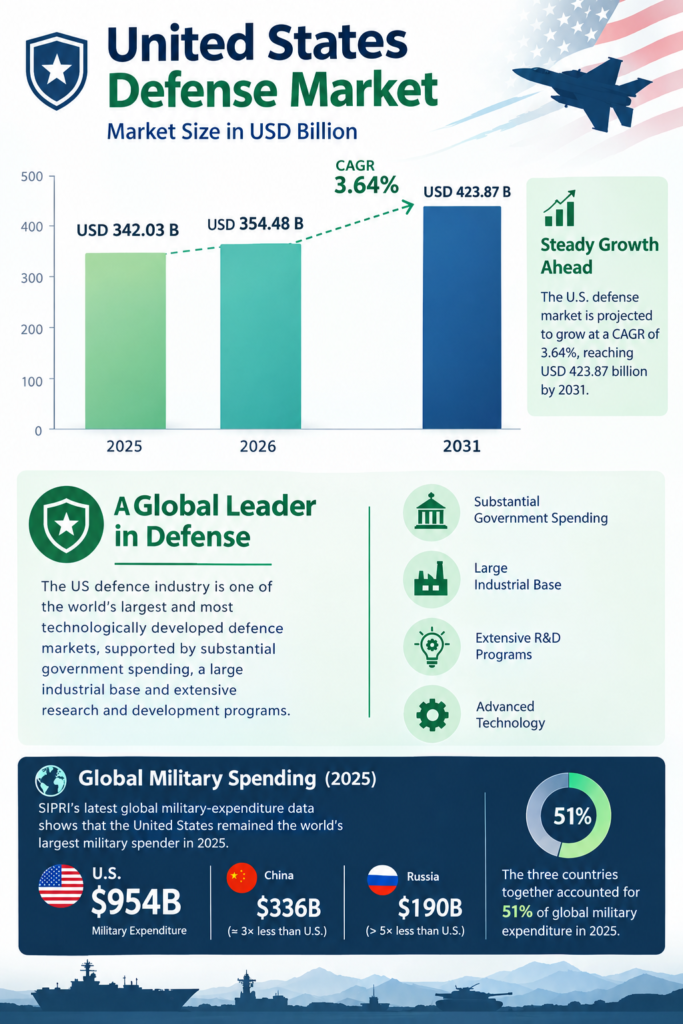
The US defence industry is one of the world’s largest and most technologically developed defence markets, supported by substantial government spending, a large industrial base and extensive research and development programs.
SIPRI’s latest global military-expenditure data shows that the United States remained the world’s largest military spender in 2025. Its $954 billion in military expenditure was almost three times China’s estimated $336 billion and more than five times Russia’s estimated $190 billion. The three countries together accounted for 51% of global military expenditure in 2025.
For defence startups, this large spending environment creates opportunities across multiple technology categories. Government demand can extend beyond conventional weapons and platforms into software, AI, cybersecurity, space systems, robotics, autonomous vehicles, advanced sensors and other emerging technologies.
The startup ecosystem is therefore becoming an important part of the broader U.S. defence technology landscape, particularly where commercial technologies can be adapted for national-security applications.
US Defence Spending and Military Budget
US military spending
According to SIPRI, the United States spent approximately $954 billion on its military in 2025, a 7.5% decline from 2024. Despite the decline, the U.S. remained the largest military spender globally, accounting for roughly one-third of worldwide military expenditure.
It is important to distinguish SIPRI’s military-expenditure measure from the U.S. federal budget. SIPRI includes a broad range of military-related government spending, while U.S. budget documents organize funding according to federal budget categories and fiscal years. SIPRI itself notes that its methodology differs from that used by NATO and other organizations.
FY2026 national defence budget
For FY2026, the U.S. Department of Defense described a $1.01 trillion National Defense Budget request. The request included $848.3 billion in discretionary funding for the Department of Defense and $113.3 billion in mandatory funding through reconciliation, for a total of $961.6 billion for the Department of Defense.
The broader national-defence figure and the Department of Defense figure should therefore not be treated as interchangeable.
The FY2026 budget places significant emphasis on modernization, missile defence, shipbuilding, munitions, space, cyber capabilities and the defence industrial base.
Department of Defense spending
The FY2026 request included major investments across military departments and defence programs. The Department of Defense said the budget included funding for readiness, modernization, shipbuilding, missile defence, long-range weapons, space and cybersecurity.
Among the areas highlighted by the department were:
- Approximately $40 billion for the U.S. Space Force
- $15.1 billion for cybersecurity
- More than $3.9 billion for hypersonic weapons
- $6.5 billion for conventional and hypersonic munitions
- Approximately $60 billion for nuclear-enterprise modernization
- Nearly $160 billion for military readiness and training
- Additional funding for the defence industrial base and missile and munitions production.
Defence R&D spending
Research and development is a major component of U.S. defence investment.
For FY2026, the Department of Defense’s budget documents show $179.1 billion for Research, Development, Test and Evaluation (RDT&E) and $205.2 billion for procurement, for a combined $384.3 billion in those two investment accounts.
The department also identified $20.3 billion for science and technology, an 8% increase from FY2025, with a focus that included areas such as hypersonics and quantum computing.
These programs are particularly relevant to defence startups because emerging companies often operate at the intersection of government R&D, commercial technology and prototype development.
Modernization spending
Modernization is another major theme of the FY2026 defence budget.
The budget request included investments in aircraft, submarines, ships, missile defence, long-range weapons, nuclear capabilities, space systems and advanced sensors. The Department of Defense also proposed $25 billion for the Golden Dome missile-defence initiative, including investments in interceptors, advanced sensors, command-and-control systems and space-based capabilities.
For defence technology companies, modernization programs can create opportunities for new entrants developing software, autonomous systems, sensors, robotics, cyber platforms and other technologies that can complement or replace legacy systems.
Read Also – Top 10 AI Companies in the USA | 10 Most Promising European AI Startups
Here are 15 U.S. defence startups and technology companies ranked by reported funding.
1. Anduril
Founded: 2017
Headquarters: Costa Mesa, California
Reported funding: $12 billion
Anduril is the largest company on this list by reported funding. The company develops AI-powered autonomous systems for multi-domain defence operations, bringing artificial intelligence, software and hardware together for national-security applications.
Its position at the top of the list highlights the growing investor interest in autonomous defence technology and software-driven military systems.
2. Shield AI
Founded: 2015
Headquarters: San Diego, California
Reported funding: $3.0 billion
Shield AI develops AI pilot software for autonomous military aircraft.
The company’s technology focuses on enabling aircraft to operate autonomously, making artificial intelligence an important part of its approach to defence aviation.
With $3.0 billion in reported funding, Shield AI ranks second among the companies in this dataset.
3. Saronic Technologies
Founded: 2022
Headquarters: Austin, Texas
Reported funding: $2.6 billion
Saronic Technologies develops surface vehicles that combine hardware, software and artificial intelligence.
The company focuses on maritime security and domain awareness, with an integrated approach that brings autonomous systems and AI together for maritime defence applications.
Founded in 2022, Saronic has reached $2.6 billion in reported funding in the supplied dataset.
4. Castelion
Founded: 2022
Headquarters: Torrance, California
Reported funding: $1.5 billion
Castelion is developing scalable, low-cost hypersonic strike missile systems.
Its focus places the company in the rapidly developing area of hypersonic defence technology, where speed, scalability and advanced engineering are central to the development of next-generation systems.
Castelion has $1.5 billion in reported funding and ranks fourth in the list.
5. Mach Industries
Founded: 2023
Headquarters: Huntington Beach, California
Reported funding: $1.1 billion
Mach Industries is developing next-generation defence systems.
Founded in 2023, the company has accumulated $1.1 billion in reported funding in the supplied data, placing it among the newer defence technology companies to reach unicorn status.
Its development reflects the broader push toward new defence platforms and technologies rather than traditional military manufacturing alone.
6. Chaos Industries
Founded: 2022
Headquarters: Los Angeles, California
Reported funding: $1.0 billion
Chaos Industries develops coherent distributed networks for multi-domain defence systems.
The company is focused on connecting defence capabilities across multiple operational environments, with distributed systems forming an important part of its technology approach.
Chaos Industries has reported funding of $1 billion and was founded in 2022.
7. True Anomaly
Founded: 2022
Headquarters: Denver, Colorado
Reported funding: $855 million
True Anomaly focuses on autonomous orbital defence systems for national space superiority.
The company operates in the growing space-defence technology sector, where autonomous systems are being developed for applications beyond Earth’s atmosphere.
With $855 million in reported funding, True Anomaly ranks seventh in the dataset.
8. Skydio
Founded: 2014
Headquarters: San Mateo, California
Reported funding: $851 million
Skydio develops intelligent flying machines powered by artificial intelligence.
The company’s technology combines AI with autonomous flight, putting it at the intersection of robotics, drones and defence technology.
Skydio has reported funding of $851 million and was founded in 2014.
9. Apex
Founded: 2020
Headquarters: Los Angeles, California
Reported funding: $719 million
Apex develops satellite buses designed to enable scalable commercial space missions.
Its position on this list reflects the increasing connection between commercial space infrastructure and the broader space technology ecosystem supporting national-security applications.
The Los Angeles-based company was founded in 2020 and has $719 million in reported funding in the supplied dataset.
10. BlueVoyant
Founded: 2017
Headquarters: New York City, New York
Reported funding: $696 million
BlueVoyant focuses on cybersecurity, bringing together internal and external cyber-defence capabilities through a cloud-native platform.
The company operates in an area where digital security has become an important part of modern national security. Its technology is designed around a unified approach to cyber defence.
BlueVoyant has reported funding of $696 million.
11. Radiant Industries
Founded: 2019
Headquarters: El Segundo, California
Reported funding: $621 million
Radiant Industries develops portable nuclear microreactors designed around a failsafe approach to clean energy.
Advanced energy infrastructure can have applications across demanding environments where reliable power is required. Radiant’s technology places nuclear energy innovation within the wider advanced-technology ecosystem represented on this list.
The company was founded in 2019 and has reported funding of $621 million.
12. Forterra
Founded: 2002
Headquarters: Clarksburg, Maryland
Reported funding: $584 million
Forterra develops autonomous vehicle systems designed to serve and support soldiers and civilians working on the front lines.
Its focus is on autonomous ground-vehicle technology, combining vehicle systems with autonomy for operational environments.
Founded in 2002, Forterra has reported funding of $584 million.
13. Long Wall
Founded: 2017
Headquarters: El Segundo, California
Reported funding: $564 million
Long Wall develops deployable missile-defence and hypersonic flight-test systems.
The company was formerly known as ABL Space Systems and focuses on technologies connected to missile defence and hypersonic testing.
Long Wall has reported funding of $564 million in the supplied dataset.
14. Epirus
Founded: 2018
Headquarters: Hawthorne, California
Reported funding: $548 million
Epirus focuses on national security technologies, including Leonidas, a software-defined high-power microwave system with efficient power management.
Its technology represents another area of modern defence development, where software and advanced electronic systems are being combined with hardware to create new capabilities.
Epirus has reported funding of $548 million.
15. Kratos Defense and Security Solutions
Founded: 1994
Headquarters: San Diego, California
Reported funding: $491 million
Kratos Defense and Security Solutions develops technology and products supporting strategic and transformational national-security programs.
The company focuses on bringing disruptive technologies to market for defence and national-security applications.
Founded in 1994, Kratos is the oldest company in this list and has reported funding of $491 million according to the supplied dataset.
What Is Driving the US Defence Startup Sector?
The companies in this list represent several different technology categories, but a number of common themes stand out.
Artificial intelligence and autonomy
AI is a major theme across the U.S. defence startup ecosystem. Companies such as Anduril, Shield AI, Saronic Technologies and Skydio are developing systems that use artificial intelligence and autonomy across different operational environments.
Rather than treating AI as a standalone software category, these companies are integrating it into aircraft, vehicles, maritime systems and other defence platforms.
Autonomous defence systems
Autonomy is another recurring theme. From autonomous aircraft and surface vehicles to autonomous orbital systems and ground vehicles, companies are developing technologies designed to reduce the amount of direct human control required during certain operations.
Space and satellite technology
The defence technology market increasingly extends into space. True Anomaly and Apex represent different parts of the space technology ecosystem, covering autonomous orbital defence systems and satellite infrastructure.
Hypersonic and missile defence
Castelion and Long Wall are focused on technologies connected to hypersonic systems and missile defence. These areas represent a significant part of next-generation aerospace and defence technology development.
Cybersecurity
Modern defence is not limited to physical systems. BlueVoyant represents the cybersecurity side of the sector, focusing on cloud-native cyber-defence capabilities.
Advanced energy
Radiant Industries brings advanced energy technology into the wider defence technology landscape through its work on portable nuclear microreactors.
US Position in Global Defence Spending
The United States occupies a central position in global military expenditure.
According to the latest SIPRI data, global military expenditure reached $2.887 trillion in 2025, up 2.9% in real terms from 2024. The United States accounted for $954 billion, or about 33% of the global total.
China was the second-largest military spender, with estimated expenditure of $336 billion, while Russia ranked third at an estimated $190 billion. The United States therefore spent substantially more than either of the next two largest military spenders.
| Country | 2025 military expenditure | Share of global spending |
|---|---|---|
| United States | $954B | 33% |
| China | $336B | 12% |
| Russia | $190B | 6.6% |
Source: SIPRI, 2025 military expenditure data. Figures are SIPRI estimates where indicated.
SIPRI’s data also shows the scale of the wider market. The five largest military spenders—the United States, China, Russia, Germany and India—accounted for 58% of global military spending in 2025.
The U.S. position is therefore significant not only because of its total spending but also because defence procurement and R&D programs provide a large potential customer base for companies developing national-security technologies.
Where U.S. Defence Startups Are Getting Funding
Defence startups can use several different funding channels as they move from research and prototypes toward production and deployment.
Venture capital
Venture capital has become an important source of funding for defence technology startups.
Companies working on AI, autonomy, robotics, cybersecurity and space technology can attract investors interested in the commercial applications of their technology as well as government markets.
The funding figures in this article demonstrate the scale that some defence technology companies have reached, with several companies reporting more than $1 billion in funding.
Defence contracts
Government contracts can provide defence startups with an important source of revenue and a pathway from prototype development to larger-scale deployment.
For a startup, securing a government contract can also provide validation for its technology and help demonstrate that the product can meet operational requirements.
Government programmes
Government-funded research and development programs can help early-stage companies develop technologies before they reach large-scale commercial or defence procurement.
The Department of Defense’s RDT&E and science-and-technology budgets provide funding across areas including emerging technologies, hypersonics and other advanced capabilities.
Strategic investors
Strategic investors can provide more than capital.
Companies from the aerospace, defence, technology and industrial sectors can bring manufacturing expertise, engineering capabilities, distribution networks and relationships with government customers.
For defence startups developing complex hardware, these strategic relationships can become particularly important as companies move from prototypes toward production.
Private equity
Private equity can also play a role in the defence technology ecosystem, particularly for companies that have moved beyond the earliest startup stage and have established products, contracts or revenue.
Private capital can support acquisitions, expansion, manufacturing capacity and other growth initiatives.
Dual-use technology investment
Dual-use technology is increasingly important to defence startups.
A dual-use company develops technology that can potentially serve both civilian and national-security applications. AI, drones, cybersecurity, satellite systems, robotics and advanced computing are examples of categories where commercial and defence applications can overlap.
This model can potentially give startups access to both government and commercial markets while reducing dependence on a single customer category.
Why These Defence Startups Matter
The companies in this dataset show how the U.S. defence technology market is expanding beyond conventional defence contractors.
AI, autonomous systems, drones, cybersecurity, space infrastructure, advanced electronics, hypersonics and energy technologies are increasingly represented in the startup ecosystem.
For investors, founders and technology professionals following the defence sector, this creates a market where software engineering and advanced hardware development increasingly overlap.
The funding figures also show the scale of capital flowing into this segment. The companies listed here collectively represent more than $25 billion in reported funding.
The Future of US Defence Technology
The US defence startup landscape is increasingly shaped by technologies that were traditionally associated with commercial technology markets, including artificial intelligence, autonomous software, cloud computing and advanced robotics.
At the same time, specialised technologies such as hypersonics, satellite systems, electronic defence and advanced nuclear energy are attracting significant attention and capital.
The 15 companies highlighted here illustrate the breadth of that market. Their technologies span multiple domains, from autonomous aircraft and maritime systems to cybersecurity, orbital defence, missile systems and advanced energy.
As defence technology continues to evolve, the intersection between software, AI and advanced hardware is likely to remain an important part of the US national-security technology ecosystem.
Conclusion
The U.S. defence startup ecosystem is expanding across AI, autonomy, robotics, cybersecurity, space, hypersonics, missile defence, advanced sensors and energy technologies.
The scale of the U.S. defence market provides an important foundation for this ecosystem. SIPRI’s latest data puts U.S. military expenditure at $954 billion in 2025 while the FY2026 U.S. national-defence budget request was approximately $1.01 trillion.
At the company level, the funding data supplied for this article highlights how much private capital has moved toward defence technology. Anduril, Shield AI, Saronic Technologies, Castelion and Mach Industries are among the companies with the largest reported funding totals in the dataset.
Together, these companies illustrate a broader shift in defence technology: the increasing convergence of AI, software, autonomous hardware, advanced manufacturing, cybersecurity and aerospace systems.
Frequently Asked Questions
Based on the funding figures supplied for this article, the 15 companies are Anduril, Shield AI, Saronic Technologies, Castelion, Mach Industries, Chaos Industries, True Anomaly, Skydio, Apex, BlueVoyant, Radiant Industries, Forterra, Long Wall, Epirus and Kratos Defense and Security Solutions.
Anduril has the highest reported funding in the supplied dataset, at $12 billion.
SIPRI estimates that U.S. military expenditure was $954 billion in 2025, making the United States the world’s largest military spender.
The U.S. Department of Defense described the FY2026 National Defense Budget request as approximately $1.01 trillion, including $961.6 billion for the Department of Defense under the budget structure described by the department.
The FY2026 Department of Defense budget documents show $179.1 billion for RDT&E and $205.2 billion for procurement. Together, the two investment accounts total $384.3 billion.
Defence startups are attracting capital across AI, autonomous systems, drones, cybersecurity, space technology, hypersonics, robotics, sensors and other dual-use technologies. Government R&D programs, defence contracts, venture capital and strategic investment can all provide funding pathways.
Companies in this list with AI or autonomy-focused descriptions include Anduril, Shield AI, Saronic Technologies and Skydio.
True Anomaly focuses on autonomous orbital defence systems, while Apex develops satellite buses for scalable commercial space missions.