
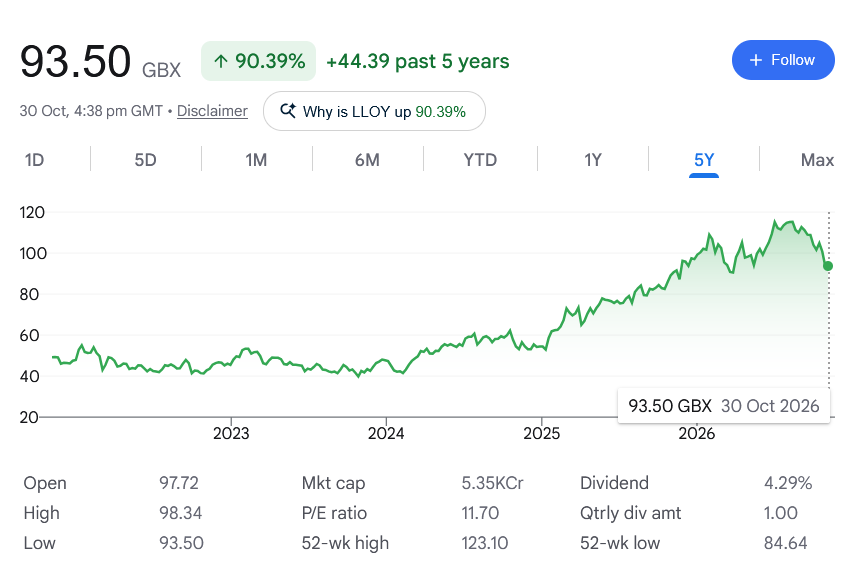
Quick answer: Lloyds (LON: LLOY) closed near 93.5p on 30 October 2026 after a post-results sell-off. Broker targets sit between 115p and 127p, with a pre-results consensus of about 116p. Our illustrative base case is roughly 99p by end-2026 and 131p by 2030, with a bear-to-bull range of 82p–117p for 2026.
Key takeaways
- Lloyds closed around 93.5p on 30 October, roughly 21% below its 2026 high of about 117.9p in early August.
- Third-quarter pre-tax profit roughly doubled to £2.33bn, yet the shares fell because Lloyds kept its 2026 targets unchanged and flagged a tougher deposit market.
- The Budget raised the bank profit surcharge from 3% to 6% for 15 months from January, a smaller hit than the market feared.
- Our bear, base and bull cases for end-2030 are 85p, 131p and 176p. These are our own illustrative estimates, not a prediction.
Lloyds share price today and market position
Lloyds Banking Group is the UK high-street giant behind Halifax, Bank of Scotland and Scottish Widows. Its shares trade on the London Stock Exchange under the ticker LLOY.
It has been a rough week. The shares closed at about 93.5p on 30 October, according to Sharecast, after sliding on results day. For context, they touched roughly 117.9p in early August, the 2026 peak so far.
| Snapshot | Figure |
|---|---|
| Ticker | LON: LLOY |
| Price (30 Oct 2026 close) | about 93.5p |
| 2026 high | about 117.9p (early August) |
| Dividends paid in the last 12 months | 4.01p (2.43p final in May + 1.58p interim in September) |
| Dividend yield at 93.5p | about 4.3% (our calculation) |
| Tangible net asset value per share | 55.4p |
| CET1 capital ratio | 13.3% |
At 93.5p the shares trade at roughly 1.7 times tangible net asset value and about nine times our estimate of 2026 earnings per share (10.4p). Both ratios are our own calculations.
Read Also – Mast Energy Share Price Forecast 2026–2030: Financial Results, Growth Outlook and Investment Risks
Lloyds Q3 2026 Financial Results
Lloyds reported on 29 October.
| Measure | Nine months 2026 | Change on 2025 | Q3 2026 |
|---|---|---|---|
| Net income | £14.8bn | +9% | £5.07bn |
| Underlying profit | £6.58bn | +36% | £2.37bn |
| Statutory profit before tax | £6.63bn | +42% | £2.33bn |
| Earnings per share | 7.6p | up from 4.8p | 2.8p |
| Net interest margin | 3.21% | up from 3.04% | 3.25% |
| Return on tangible equity | 17.9% | up from 11.9% | 19.5% |
| Cost-to-income ratio | 49.3% | n/a | 47.2% |
| CET1 ratio | 13.3% | down from 13.8% | 13.3% |
Other numbers worth knowing: lending reached £495.5bn, up 3% so far this year, and customer deposits were £502.8bn, up £1.9bn in the quarter. The impairment charge rose to £313m from £176m a year earlier, still modest for a bank this size.
Why the shares fell despite strong profit
Three things combined.
- Unchanged targets. Lloyds kept its 2026 guidance: underlying net interest income above £14.9bn and return on tangible equity above 16%. Investors had hoped for an upgrade. Reuters reported the shares fell as much as 6% in early trading.
- Deposit competition. CFO William Chalmers said the deposit market is tighter and more competitive, with pressure from non-UK banks, although Lloyds’ own deposits stayed broadly stable. HSBC flagged similar pressure earlier in the week. RBC had already downgraded the stock on 16 October on margin concerns.
- The Budget. The results landed one day after the Chancellor raised the bank profit surcharge.
Saxo Markets strategist Neil Wilson put it neatly: investors worried about the tax rise and now want a higher bar for earnings.
The Budget bank tax: how much will it cost?
In his 28 October Budget, Chancellor John Healey raised the surcharge on banks’ UK profits above £100m from 3% to 6% for 15 months from January. Earlier press reports had pointed to a rise to 8%, so the final version is smaller and shorter than feared.
Here is our rough arithmetic. Nine-month statutory profit before tax of £6.6bn annualises to about £8.9bn. Three extra percentage points on that is roughly £0.27bn a year, or about 4% of annualised post-tax profit. This is our own estimate, not company guidance, and the true tax base will differ.
What analysts are saying
| Broker | Rating | Price target | Date |
|---|---|---|---|
| RBC Capital Markets | Sector Perform (cut from Outperform) | 115p (from 124p) | 16 Oct 2026 |
| Jefferies | Buy | 127p | 2 Sep 2026 |
| JPMorgan | Neutral | 123p | 15 Sep 2026 |
| Deutsche Bank | Buy | 125p | 31 Jul 2026 |
| Berenberg | Hold | 117p | 24 Jun 2026 |
On consensus, MarketBeat’s tally of nine analysts (four buy, four hold, one sell) averaged a 12-month target of about 116p with an overall Hold rating on 20 October. Stockopedia showed a higher consensus of 126.13p on 8 October. Aggregators use different broker sets and dates, so the numbers differ.
From 93.5p, a 116p target implies about 24% upside. But note that most of these targets pre-date the Q3 results and the Budget. Expect revisions over the coming days and check the latest before you rely on any figure.
Lloyds share price forecast 2026–2030: our scenarios
We keep the method simple so you can check it: share price = estimated earnings per share (EPS) × price-to-earnings (P/E) multiple.
We start from nine-month EPS of 7.6p and assume a fourth quarter in line with Q3 (about 2.8p), giving roughly 10.4p for 2026. From there we vary the earnings path and the multiple.
| Scenario | P/E multiple | 2026 EPS | 2027 EPS | 2028 EPS | 2029 EPS | 2030 EPS |
|---|---|---|---|---|---|---|
| Bear | 8x | 10.2p | 9.5p | 10.0p | 10.3p | 10.6p |
| Base | 9.5x | 10.4p | 11.0p | 12.0p | 12.9p | 13.8p |
| Bull | 11x | 10.6p | 12.0p | 13.0p | 14.5p | 16.0p |
Implied year-end share price (rounded):
| Year | Bear | Base | Bull |
|---|---|---|---|
| 2026 | 82p | 99p | 117p |
| 2027 | 76p | 105p | 132p |
| 2028 | 80p | 114p | 143p |
| 2029 | 82p | 123p | 160p |
| 2030 | 85p | 131p | 176p |
Why those multiples? On our 10.4p estimate, the shares trade at about 9x today and were near 10x in mid-October. The August peak of about 117.9p equals roughly 11x, so that is our bull multiple. Eight times is where a nervous market could price a UK bank if earnings stall.
What each scenario assumes
- Bear: deposit competition squeezes margins, credit losses rise, the tax hit lingers and earnings drift sideways near 10p. The market keeps bank multiples low.
- Base: Lloyds delivers its 2026 guidance, the structural hedge lifts income, buybacks keep shrinking the share count, and the extra tax is absorbed. EPS grows by high single digits a year after 2027.
- Bull: margins hold up, Lloyds reaches its 2030 return target of around 20% early, buybacks are topped up and investors pay the multiple they paid in August.
Our base case for end-2027 (105p) sits about 10% below the pre-results analyst consensus of 116p. That gap reflects our more cautious multiple after the sell-off and the extra tax; most broker targets pre-date both. A share price four years out is educated guesswork, so treat the 2029 and 2030 rows as ranges, not promises.
Read Also – NatWest Share Price Forecast 2030: Future Growth, Predictions and Risks
Year-by-year outlook
2026. The path is set by Lloyds’ guidance and the Q4 numbers. An up-to-£1.0bn buyback is due to complete by 27 January 2027, the day before full-year results.
2027–2028. The higher surcharge starts in January 2027 and will weigh on profit. Against that, management expects structural hedge income of more than £7bn in 2026 and more than £8bn in 2027, plus around £2bn of gross cost savings between 2027 and 2030. It targets return on tangible equity above 18% in 2028.
2029–2030. Under its Accelerate 2030 plan, Lloyds targets mid-single-digit net income growth a year, a cost-to-income ratio below 45%, return on tangible equity of about 20% and capital generation above 225 basis points by 2030. These are management targets, not guarantees.
Key growth drivers for Lloyds
1. The structural hedge
Lloyds locks in longer-term interest rates on part of its balance sheet. As older, lower-yielding positions roll off, income rises. Management expects hedge income above £9bn by 2030.
2. Cost discipline and technology
The cost-to-income ratio fell to 47.2% in Q3. Lloyds plans more than £13bn of investment through 2030 and expects around £2bn of savings from technology, automation and AI.
3. Capital returns
Lloyds started 2026 with a £1.75bn buyback, announced a further £1.0bn in July and lifted its interim dividend 30% to 1.58p. The share count is down more than 18% since the end of 2021, which lifts earnings per share even when profit is flat.
4. Diversification
The strategy leans on wealth management, insurance and pensions through Scottish Widows, plus newer fee businesses. The Curve acquisition has completed. More fee income would make earnings less sensitive to interest rates.
5. Lending growth
Lending rose 3% in the first nine months to £495.5bn, with commercial banking growing fastest in Q3.
Investment risks to consider
- Margin squeeze. If rivals compete harder for deposits, Lloyds pays more to fund its loans. This is what RBC and the CFO both pointed to.
- More tax. The 15-month surcharge could be extended, or other levies could follow.
- Credit quality. Impairments rose to £313m in Q3. Management expects an asset quality ratio of about 25 basis points this year and 25–30 basis points through 2030. A weaker economy would push it higher.
- Conduct costs. Motor finance cost Lloyds heavily in 2025. Remediation is now small at £61m so far this year, but a new charge would hurt.
- Economy and rates. Lloyds is a UK-focused bank, so unemployment, house prices and Bank of England decisions matter.
- Execution. Accelerate 2030 needs big investment and big savings to deliver on time.
What to watch next
- Broker target revisions after the Q3 results and the Budget
- Peer results from NatWest and Barclays for clues on deposit pricing
- The higher surcharge taking effect in January
- 27 January 2027: the current buyback is due to finish
- 28 January 2027: full-year 2026 results, final dividend and the next capital return decision
- Bank of England rate decisions and UK housing data
Read Also- Kodal Minerals Share Price Prediction 2026–2030: Can Lithium Demand Drive Future Growth?
Conclusion: where next for Lloyds shares?
Lloyds is making more money, spending less to do it and handing a growing share of profit back to shareholders. The sell-off was about expectations, not a collapse in results. At around 93.5p the shares trade well below their August high and below most broker targets.
The next leg depends on three things: whether deposit competition really erodes margins, how much the higher bank tax bites, and whether Lloyds can lift its targets in January. Watch those, and treat any single price forecast, including ours, with healthy scepticism.
Sources:
- Lloyds Banking Group, Q3 2026 Interim Management Statement (29 Oct 2026)
- Lloyds Banking Group, 2026 half-year results (30 Jul 2026)
- Lloyds Banking Group Plc price data
Disclaimer: This article is for information and education only. It is not financial advice or a personal recommendation to buy or sell any security. Forecasts are our own illustrative estimates based on stated assumptions and may prove wrong. Analyst targets change often. The value of investments can fall as well as rise, and you may get back less than you invest. Do your own research or speak to a regulated adviser.