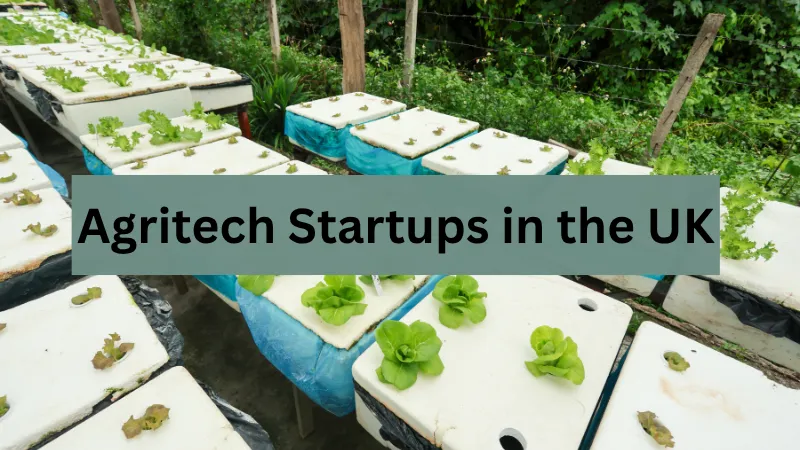
The UK is becoming a growing hub for agricultural technology. Agritech startups are using new technologies to help farmers grow more crops, reduce costs, use fewer chemicals, automate farm work, and deal with changing weather conditions.
From AI and crop science to farming robots and greenhouse technology, UK agritech startups are working on solutions for many different parts of agriculture.
The sector is also attracting more investment. According to Beauhurst, UK agritech companies raised £367 million in 2025, the highest amount recorded by the research firm. Beauhurst tracks 250 active agritech companies in the UK, which have raised a total of £1.64 billion in equity funding.
Government support for agricultural technology is also growing. In April 2026, the UK government announced around £50 million in public and private investment to help bring new farming technologies to the market. In August, it announced another £20 million funding opportunity focused on agricultural robots and automated farming systems.
Here are 10 UK agritech startups to watch in 2026, selected based on their recent funding, investments, technology development, and business activity.
Lambda Agri is a UK agritech company working on technology that could help improve greenhouse farming.
The company has developed a material that can be added to greenhouse films and coatings. It changes unused ultraviolet light from the sun into red light, which plants can use during photosynthesis.
In September 2026, Oxford Innovation Finance’s Angel Investment Network invested in Lambda Agri. The funding will help the company develop and commercialise its technology.
Lambda Agri’s technology could help greenhouse growers improve crop production without needing extra energy. This makes the company part of the growing controlled-environment agriculture market.
EcoNomad Solutions is developing technology that helps livestock farms make better use of agricultural waste.
In August 2026, the UK startup secured part of a £400,000 funding round, including £230,000 from the British Design Fund and an Innovate UK Investor Partnership grant.
The company’s BioNomad system turns farm waste into biogas and biofertiliser. It is mainly designed for small and medium-sized livestock farms.
The technology could help farms deal with waste while also producing renewable energy and fertiliser. It is aimed at challenges such as high energy costs, expensive fertiliser, methane emissions, and waste management.
Dogtooth is a Cambridge-based agritech company developing robots for farms.
Its robots use AI and computer vision to work in farming environments and perform tasks such as harvesting soft fruit.
In July 2026, Dogtooth raised €16 million in funding. The round included investors such as 24Haymarket, ACF Investors, EMV Capital, Innovate UK, and Kineo Finance.
The company is developing its technology at a time when many farms are looking for ways to deal with labour shortages and rising operating costs.
The UK government is also supporting agricultural automation. In August 2026, it announced £20 million in funding for agricultural robots and automated systems that can help with planting, growing, and harvesting crops.
Moa Technology is an Oxford-based agricultural biotechnology company working on new herbicides.
Its technology is focused on tackling weeds that have become resistant to existing herbicides. This is an important issue for farmers because resistant weeds can make crop production more difficult and expensive.
In July 2026, Moa Technology raised £22.2 million in Series C funding. The round was co-led by Oxford Science Enterprises and Supernova Invest, with participation from Agri Investment Fund, GrainInnovate, Infinity Investment Partners, and Magdalen College Oxford, along with existing investors.
Moa has developed a platform for discovering new ways to protect crops from weeds. It has also worked with agricultural companies including Nufarm, Gowan, Certis Belchim, and Corteva Agriscience.
In August 2026, the company received more than £900,000 in non-dilutive funding through the Defra Farming Innovation Investor Partnership programme. The funding will support work on solutions for controlling blackgrass in English agriculture.
Cordon Technologies is developing technology that helps farmers spray crops more precisely.
The company is working on a precision spraying system that can adjust treatments while farming is taking place. The aim is to help farmers use pesticides and fertilisers more efficiently.
Cordon secured the first close of a £1 million funding round in June 2026, led by the British Design Fund.
The company is focused on helping farmers reduce the amount of agricultural chemicals they use while maintaining crop production.
With farming costs increasing and environmental concerns becoming more important, technologies that allow farmers to use inputs more efficiently are gaining attention.
Resurrect Bio is a London-based agricultural biotechnology startup developing crops that can better resist diseases.
The company combines AI and gene-editing technology to study plant immune systems and identify ways to improve natural disease resistance.
In May 2026, Resurrect Bio raised €8.8 million in Series A funding. Corteva, through its Corteva Catalyst platform, led the round. Calculus Capital, Pymwymic, UKI2S, SynBioVen, and AgFunder also participated.
The company said the funding brought its total funding to around $12.4 million.
Resurrect Bio’s technology could help develop crops that are more resistant to diseases and reduce the need for chemical crop protection.
SugaROx is a UK agricultural biotechnology company developing new types of crop biostimulants.
The company focuses on a natural plant molecule called trehalose-6-phosphate, or T6P. This molecule plays a role in how plants manage carbon and nutrients.
In May 2026, SugaROx received £2.5 million from The Mosaic Company as part of its Series A funding.
The investment will help the company carry out more field testing, complete regulatory work, and prepare its first product for commercial launch.
SugaROx is also working on additional products and running field trials in different markets. Its work reflects the growing interest in biological products that can help crops grow and handle difficult conditions.
Cytotrait is a biotechnology startup that came out of the University of Manchester.
The company is developing technology that could help scientists make targeted changes to plants and create new crop traits.
Cytotrait raised £3 million in seed funding in March 2026. Northern Gritstone led the funding round, with investment from UKI2S and the Northern Universities Venture Fund.
Its technology, called the Mutant Organelle Selection System (MOSS), is designed to support targeted genetic changes in plant structures such as chloroplasts and mitochondria.
The company plans to use the funding to develop new crop traits and explore its technology across different types of crops.
Bindbridge is a Cambridge-based agricultural biotechnology company that combines AI with molecular research.
The startup raised $3.8 million in early-stage funding in March 2026 to develop new crop protection technologies.
Bindbridge uses molecular AI to discover and design new ways to target proteins in agricultural pests and weeds. Its research includes molecular glues, which could potentially be used to develop new herbicides, insecticides, and fungicides.
The company is working on solutions for crop losses caused by pests and weeds, as well as the growing problem of resistance to existing agricultural chemicals.
Its combination of AI and biotechnology shows how new technologies are changing the way agricultural products are discovered and developed.
Wild Bioscience is an Oxford University spinout working on crops that can better handle changing environmental conditions.
The company combines AI, evolutionary biology, and gene-editing technology to identify useful plant traits and develop new crop varieties.
In 2025, Wild Bioscience raised £45 million in Series A funding, led by the Ellison Institute of Technology. The company continued expanding its crop development work in 2026.
In July 2026, Wild Bioscience also acquired UK wheat breeding company F1 Seed.
The deal brought together Wild Bioscience’s AI-based crop development technology and F1 Seed’s experience in wheat breeding. The company is now working toward developing wheat varieties that can better meet the needs of farmers in changing conditions.
The latest developments show that UK agritech startups are working on a wide range of agricultural problems.
One important area is agricultural robotics. Companies such as Dogtooth are developing robots that can perform farm tasks and reduce the amount of manual work required.
Another major area is crop biotechnology. Moa Technology, Resurrect Bio, Cytotrait, SugaROx, and Wild Bioscience are using biotechnology, AI, gene editing, and plant science to improve crops and develop better ways to protect them.
Other startups are working on different parts of the agricultural system. Lambda Agri is focused on greenhouse technology, while EcoNomad Solutions is working on farm waste and renewable energy.
Government funding is also helping the sector grow. The UK’s Farming Innovation Programme and Innovate UK are supporting projects that aim to move new agricultural technologies from research and development into practical use on farms.
Farmers around the world are facing several challenges, including rising costs, labour shortages, crop diseases, changing weather, and pressure to reduce environmental impact.
Agritech startups are developing technology that could help farmers respond to these challenges.
The UK has a growing ecosystem of companies working on AI, robotics, biotechnology, precision farming, crop protection, greenhouse technology, and renewable energy.
This means the country’s agritech sector is no longer focused only on traditional farm management software. New startups are working on technologies that can directly change how crops are grown, protected, harvested, and processed.
The UK agritech startup sector in 2026 covers a wide range of technologies and ideas.
Dogtooth is developing farming robots, Moa Technology is working on new herbicides, Wild Bioscience is developing new crop varieties, and Lambda Agri is looking at ways to improve greenhouse farming.
At the same time, companies such as Cordon Technologies, Cytotrait, Bindbridge, Resurrect Bio, and SugaROx are developing new approaches to crop protection and agricultural biotechnology.
With continued investment from private investors and government-backed programmes, the UK agritech ecosystem is continuing to develop. These startups show how technology is becoming an increasingly important part of modern farming and food production.