TerraBlaster, a Redwood City, California-based agricultural technology startup, has raised $12.5 million in seed funding to develop and scale its real-time soil monitoring technology.
The round was led by Ulu Ventures, with participation from Khosla Ventures, Trailhead Capital, Builders Vision, Bidra, Ag Startup Engine, Reservoir, Sunna, Plug and Play, GrainInnovate, and the Hort Innovation Venture Fund.
The latest funding brings TerraBlaster’s total funding to $16.5 million. The company plans to use the capital to mass-produce its soil sensors, expand its agronomy and data analytics teams, and increase field testing ahead of commercial operations planned for 2027.
“With our technology, there’s no reason to suffer suboptimal yields by applying nutrients to a field based on low-resolution or old measurements,” says cofounder and CEO Jorge Heraud. “We are quickly moving to a future where real-time measurements enable precise soil fertilization, all in one pass.”
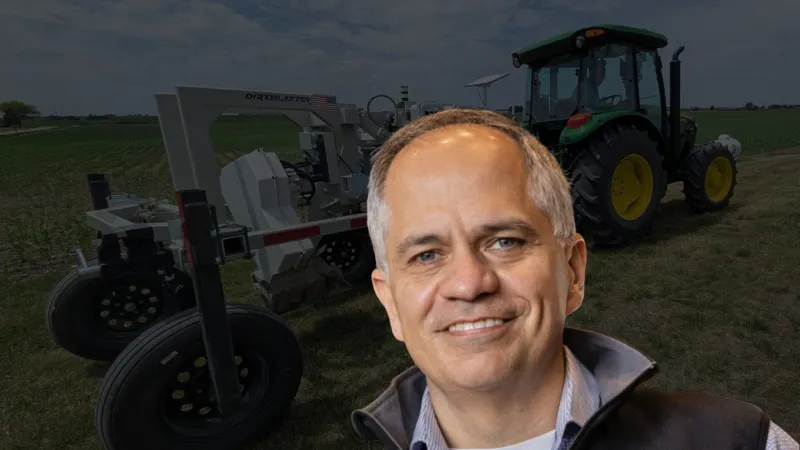
TerraBlaster uses laser-induced breakdown spectroscopy (LIBS), a technology originally used in space exploration, in rugged sensors that can be pulled through farmland by tractors or ATVs.
The sensors collect real-time data on nitrogen, phosphorus, potassium, pH, and other soil nutrients. The information is turned into detailed soil maps that help farmers apply fertilizer more precisely.
By identifying nutrient differences across fields, TerraBlaster aims to help farmers reduce fertilizer costs, improve crop yields, and protect soil health.
The company has completed extensive testing in Iowa and is conducting demonstrations with growers and agricultural retailers across the Midwest. Its first commercial systems are expected to be delivered in spring 2027.
TerraBlaster was co-founded by Jorge Heraud, who previously co-founded Blue River Technology, an agricultural robotics company later acquired by John Deere for $305 million.