Technology changes quickly, but retiring technology responsibly is rarely simple.
Businesses routinely replace laptops, desktops, servers, storage systems, networking equipment, smartphones, and data center infrastructure. Once these assets reach the end of their useful life within an organization, they cannot simply be thrown away, handed to an unknown recycler, or stored indefinitely.
Many devices still contain sensitive business or customer data. Others retain significant resale value. Equipment that cannot be reused may need to enter an appropriate electronics recycling stream. And throughout the process, businesses need documentation showing where their assets went and how they were handled.
This is where professional IT Asset Disposition (ITAD) services become essential.
ITAD provides a structured approach to collecting, tracking, securing, sanitizing, evaluating, remarketing, recycling, and documenting retired technology. Done correctly, it helps organizations protect information, maintain asset accountability, recover residual value, reduce unnecessary electronic waste, and simplify complex IT refresh and decommissioning projects.
For enterprises managing hundreds or thousands of devices, IT asset disposition should not be treated as an end-of-life cleanup exercise. It should be an integrated part of the technology lifecycle.
What Are IT Asset Disposition Services?
IT Asset Disposition services are specialized services for securely and responsibly managing IT equipment that an organization no longer needs.
ITAD can cover the entire process from equipment collection to final disposition.
Depending on the organization and project, services may include:
- IT asset inventory and auditing
- Equipment collection and logistics
- Secure chain of custody
- Data sanitization
- Hard drive and media destruction
- Asset testing and grading
- IT equipment refurbishment
- IT asset remarketing
- Value recovery
- Electronics recycling
- Data center decommissioning
- Documentation and reporting
- Multi-site and cross-border ITAD
The goal is not simply to “get rid of old computers.”
Professional ITAD asks a more valuable question:
What is the most secure, responsible, and economically appropriate outcome for each individual asset?
A functioning three-year-old laptop, for example, should not necessarily receive the same treatment as a failed hard drive containing sensitive data or a damaged server that has no remaining reuse value.
ITAD creates a controlled process for making those decisions.
Why Businesses Need Professional IT Asset Disposition
The risk associated with an IT asset does not disappear when an employee stops using it.
In some cases, risk actually increases.
A laptop sitting in an unsecured storage room may still contain customer information. A server removed during a data center migration may retain confidential databases. A smartphone assigned to a former employee may contain email, credentials, business contacts, or corporate applications.
At the same time, storing obsolete technology indefinitely is not an effective strategy. Equipment depreciates, consumes valuable space, becomes harder to resell, and can eventually turn into a larger disposal problem.
Professional ITAD addresses four fundamental business priorities:
Data security. Asset accountability. Value recovery. Responsible disposition.
These priorities should remain connected throughout the entire disposition lifecycle.
Our IT Asset Disposition Services
1. IT Asset Collection and Secure Logistics
A successful ITAD project begins with controlled collection.
Assets may need to be collected from corporate offices, warehouses, remote employees, branch locations, data centers, retail sites, or multiple facilities across different regions.
The logistics process should account for the type, quantity, location, sensitivity, and physical condition of the equipment.
For larger projects, this may involve palletization, serialized manifests, secure containers, scheduled pickups, dedicated transportation, or coordinated collections across multiple locations.
The objective is to establish control as soon as assets leave the organization’s custody.
A documented handoff creates the beginning of the ITAD chain of custody.
For distributed organizations, centralized logistics can also reduce the administrative burden of coordinating separate disposal vendors for every office.
2. IT Asset Inventory and Serialized Tracking
You cannot securely dispose of an asset if you cannot account for it.
Asset inventory and reconciliation are therefore fundamental parts of professional IT asset disposition.
Equipment can be recorded using information such as:
Asset tag → Serial number → Manufacturer → Model → Configuration → Storage media → Condition → Location → Disposition status
Serialized tracking creates visibility throughout the process.
When equipment arrives at an ITAD processing facility, received assets should be reconciled against available manifests or customer records. Discrepancies can then be identified and investigated rather than disappearing into an unstructured disposal process.
This becomes particularly important for enterprise refresh projects involving thousands of devices.
At the end of the project, the organization should be able to determine the final disposition of each tracked asset.
3. Secure Data Sanitization
Data security is one of the most important components of ITAD.
Retired devices may contain confidential information long after they have been removed from active service.
This can include customer data, employee records, financial information, intellectual property, internal communications, passwords, databases, proprietary files, source code, and regulated information.
Simply moving files to the recycle bin or performing a basic operating-system reset should not be confused with an enterprise media sanitization program.
Data-bearing devices should be processed using sanitization methods appropriate to the media, data sensitivity, security policy, and applicable requirements.
Depending on those factors, sanitization may involve techniques such as clearing, purging, cryptographic erase, or physical destruction.
Organizations frequently use frameworks such as NIST SP 800-88 when developing media sanitization policies and procedures.
Equally important is validation.
Businesses should not only ask:
“Was the data erased?”
They should also ask:
“How was it sanitized, was the process validated, and can the outcome be documented?”
That distinction is essential for security audits and risk management.
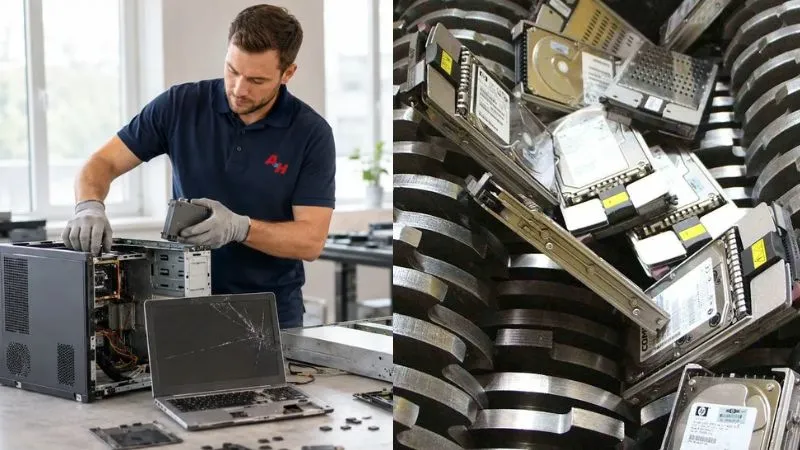
4. Hard Drive and Data-Bearing Media Destruction
Not every storage device is suitable for reuse.
Some organizations require physical destruction because of internal security policies, contractual requirements, equipment failure, media condition, or the sensitivity of the information involved.
Media destruction services may apply to hard disk drives, solid-state drives, tapes, optical media, flash storage, and other data-bearing devices.
The destruction method should be appropriate for the specific media technology and organizational requirements.
A professional process should also maintain accountability.
Storage media should remain associated with asset or serial records where required, and customers should receive appropriate documentation confirming the disposition outcome.
Physical destruction should be a deliberate security decision—not an automatic response to every data-bearing device.
Where equipment and storage media can be securely sanitized and reused, reuse may preserve considerably more economic value.
5. IT Asset Testing and Grading
Retired does not mean worthless.
Many organizations replace technology according to predetermined refresh cycles rather than because the equipment has stopped working.
A laptop retired after three or four years may still have years of useful life remaining. Servers, switches, smartphones, memory, processors, storage components, and other equipment can also retain secondary-market demand.
After data security requirements have been addressed, reusable equipment can be tested and graded.
Evaluation may consider:
- Hardware specifications
- Functional condition
- Cosmetic condition
- Battery health
- Component configuration
- Age
- Repair requirements
- Market demand
- Expected resale value
Testing allows assets to be routed toward the most appropriate next step rather than treating every device as electronic waste.
6. IT Asset Remarketing and Value Recovery
One of the biggest differences between professional ITAD and basic electronics recycling is asset value recovery.
Retired business technology can retain substantial residual value.
An experienced ITAD provider can identify reusable equipment, prepare it for secondary markets, and manage the remarketing process.
Potential remarketing categories include laptops, desktops, smartphones, servers, networking equipment, enterprise storage, CPUs, memory, GPUs, and other commercially viable components.
Successful remarketing depends on several factors, including equipment age, condition, configuration, market demand, timing, location, and sales channels.
This is why businesses should avoid keeping retired technology in storage unnecessarily.
Technology depreciates rapidly.
A device worth several hundred dollars today may have significantly less market value after sitting unused for another year.
A structured ITAD program helps organizations move reusable assets into secondary markets more efficiently and can return recovered value to the business according to agreed commercial arrangements.
7. Electronics and E-Waste Recycling
Some equipment will have little or no practical reuse value.
Damaged devices, obsolete systems, broken peripherals, failed components, and equipment that cannot be economically refurbished may need to be recycled.
Responsible IT asset recycling focuses on controlled processing and material recovery rather than uncontrolled disposal.
Electronics can contain materials such as steel, aluminum, copper, plastics, circuit-board materials, glass, batteries, and other components.
A professional recycling process separates appropriate material streams and directs them toward qualified downstream processors.
Businesses should understand where their equipment ultimately goes.
Choosing an ITAD provider should therefore involve questions about downstream vendor management, facility controls, relevant certifications, environmental practices, and documentation—not simply the price paid per pallet.
8. Data Center Decommissioning
Data center ITAD is considerably more complex than collecting office laptops.
A decommissioning project may involve servers, racks, storage arrays, switches, networking hardware, cabling, power equipment, drives, and other infrastructure.
Projects may occur because of cloud migration, infrastructure refresh, facility closure, consolidation, merger and acquisition activity, or relocation.
A structured data center decommissioning service may include project planning, asset inventory, equipment identification, secure removal, drive handling, sanitization or destruction, packing, transportation, testing, remarketing, recycling, and final reporting.
Coordination is especially important because data center equipment can contain both highly sensitive information and significant residual financial value.
Treating an entire data center as scrap can result in unnecessary value loss.
9. Office Closure and Technology Refresh ITAD
Office closures, relocations, workforce reductions, and large-scale device refreshes can create hundreds or thousands of surplus IT assets within a short period.
These projects often operate under strict deadlines.
Businesses may need to vacate a property while simultaneously inventorying equipment, protecting sensitive information, recovering leased assets, coordinating transportation, and determining what can be reused.
A project-based ITAD program provides one controlled workflow.
Assets can be categorized for redeployment, return, remarketing, recycling, donation where appropriate, or secure destruction.
This reduces the risk of valuable or data-bearing equipment being left behind during a fast-moving transition.
10. Remote Employee IT Asset Recovery
Remote and hybrid work have created a new ITAD challenge.
Corporate devices are no longer located exclusively inside corporate buildings.
When employees leave an organization or receive replacement equipment, businesses may need to recover laptops, monitors, smartphones, docking stations, and other hardware from hundreds of individual addresses.
A remote asset recovery program can coordinate device return and route equipment into the appropriate ITAD process.
Once returned, assets can be inventoried, sanitized, tested, redeployed, remarketed, or recycled.
This helps organizations maintain control of equipment even when their workforce is geographically distributed.
11. Multi-Site and Cross-Border ITAD
Large enterprises may operate across dozens of locations and multiple countries.
Without centralized governance, each location may develop its own disposal process.
One office uses a recycler. Another stores equipment. A third sells devices locally. Another ships assets internationally.
This fragmentation creates security, reporting, compliance, and procurement challenges.
Global and cross-border ITAD services provide a framework for coordinating disposition across regions while accounting for local regulatory requirements.
Cross-border projects require particular attention because used electronics and electronic waste may be treated differently depending on the jurisdictions involved, equipment condition, destination, and intended use.
International ITAD may therefore require consideration of customs, data protection, environmental requirements, transportation rules, and frameworks governing transboundary movements of electronic waste.
Where practical, organizations should also evaluate whether local reuse, remarketing, or recycling is preferable to unnecessary international transportation.
ITAD Chain of Custody: Maintaining Control From Pickup to Final Disposition
Chain of custody should run through every ITAD service.
Consider a typical asset journey:
Corporate Location → Secure Collection → Transportation → Processing Facility → Data Sanitization → Testing → Remarketing or Recycling → Final Reporting
Each transition should be controlled and documented according to the requirements of the project.
This creates an audit trail that can help businesses determine where assets were handled and what happened to them.
For data-bearing equipment, chain of custody is particularly important because security risk exists until the information has been appropriately sanitized or the media securely destroyed.
ITAD Documentation and Reporting
A professional ITAD project should end with evidence—not uncertainty.
Depending on the service and project requirements, reporting may include:
- Asset inventory reports
- Serial-number reconciliation
- Sanitization records
- Certificates of data destruction
- Recycling documentation
- Remarketing reports
- Financial recovery reports
- Exception reports
- Final disposition records
Centralized reporting becomes particularly valuable for organizations managing multiple locations.
Instead of collecting disconnected spreadsheets and certificates from numerous vendors, enterprise IT teams can maintain more consistent disposition records.
ITAD and Regulatory Compliance
ITAD intersects with several areas of organizational compliance.
The exact requirements depend on the business, industry, jurisdiction, type of information, and destination of the equipment.
Relevant considerations can include data privacy, cybersecurity, environmental rules, records management, electronic waste regulations, contractual obligations, and industry-specific requirements.
Organizations may also consider ITAD provider certifications and management standards as part of vendor due diligence.
Depending on the service and geography, relevant certifications may include electronics recycling standards such as R2v3 or e-Stewards, as well as management-system standards such as ISO 14001 and ISO/IEC 27001.
Certification alone, however, should not replace vendor assessment.
Businesses should evaluate the actual facility, scope of certification, data-security controls, downstream vendors, insurance, permits, processes, and reporting capabilities relevant to their project.
IT Asset Disposition and Sustainability
ITAD can also support broader circular-economy and sustainability goals.
The most environmentally responsible outcome is not necessarily recycling every device immediately.
If equipment remains functional, extending its useful life through redeployment, refurbishment, or resale can preserve the value already embedded in that technology.
A practical IT asset hierarchy is:
Redeploy → Reuse → Refurbish → Remarket → Recover Parts → Recycle
Recycling becomes the appropriate route when equipment can no longer be safely or economically reused.
ITAD reporting can also provide organizations with measurable information about how equipment was handled, supporting more evidence-based sustainability reporting.
ITAD vs. Electronics Recycling: What Is the Difference?
The terms are sometimes used interchangeably, but they describe different scopes.
Electronics recycling focuses primarily on processing equipment and recovering recyclable materials.
IT asset disposition covers the entire retirement lifecycle.
That includes inventory, logistics, chain of custody, data sanitization, testing, refurbishment, remarketing, recycling, documentation, and value recovery.
In other words:
Recycling is one potential outcome of ITAD—not the entire ITAD process.
This distinction matters for businesses because immediately recycling valuable equipment can destroy recoverable financial value.
When Does a Business Need ITAD Services?
Organizations commonly require IT asset disposition during:
Technology refreshes: Replacing employee laptops, desktops, phones, or other devices.
Data center decommissioning: Retiring servers, storage, and networking infrastructure.
Cloud migration: Removing physical infrastructure after workloads move to cloud environments.
Office closures: Clearing IT equipment from a facility securely and on schedule.
Mergers and acquisitions: Consolidating overlapping technology estates.
Employee offboarding: Recovering corporate technology from departing employees.
Lease returns: Preparing leased hardware for return.
Infrastructure upgrades: Replacing servers, storage, or networking equipment.
Business restructuring: Managing surplus equipment across changing locations.
ITAD can also operate as an ongoing program rather than a one-time project.
For larger organizations, recurring pickups and standardized disposition procedures can prevent retired technology from accumulating in storage.
How to Choose an IT Asset Disposition Company
Price matters, but it should not be the only criterion.
A business is effectively entrusting an ITAD provider with both physical assets and potentially sensitive information.
Ask prospective providers:
How are assets tracked?
What happens immediately after collection?
How is data sanitized and validated?
What happens if sanitization fails?
Can we obtain serial-level reporting?
How are reusable assets remarketed?
How is recovered value calculated?
Which downstream recyclers are used?
Can downstream processes be audited?
Which facilities and services are covered by relevant certifications?
Can you support multiple locations or countries?
What documentation will we receive at project completion?
A credible provider should be able to explain the complete disposition chain.
Frequently Asked Questions About IT Asset Disposition Services
What does ITAD stand for?
ITAD stands for IT Asset Disposition. It describes the secure and responsible management of IT equipment when it is retired, reused, sold, recycled, or destroyed.
What equipment can an ITAD company handle?
ITAD providers may handle laptops, desktops, smartphones, tablets, servers, hard drives, SSDs, storage systems, networking equipment, data center infrastructure, printers, monitors, telecom equipment, and other business electronics.
Is ITAD the same as IT recycling?
No. Recycling is one part of ITAD. IT asset disposition also includes inventory, logistics, data sanitization, testing, remarketing, value recovery, and reporting.
Can retired IT equipment still have value?
Yes. Many devices retain secondary-market value, particularly newer laptops, smartphones, servers, networking equipment, and enterprise components.
What happens to data before IT equipment is resold?
Data-bearing equipment should undergo an approved sanitization process before reuse or remarketing. The appropriate process depends on the storage technology, information sensitivity, organizational policy, and applicable requirements.
What happens if a hard drive cannot be sanitized?
Depending on the organization’s policy and risk requirements, failed or unsuitable media may need to be physically destroyed through an approved process.
What is a certificate of data destruction?
A certificate of data destruction documents that specified data-bearing media or assets underwent the stated destruction or sanitization process. The exact content and evidentiary value depend on the provider and procedure used.
Can ITAD services support multiple business locations?
Yes. Multi-site ITAD programs can coordinate collections and reporting across offices, data centers, warehouses, retail sites, and other facilities.
Can ITAD companies handle international projects?
Providers with appropriate capabilities can support international and cross-border ITAD projects. Such projects require additional consideration of local regulations, customs, data protection, logistics, and electronic-waste rules.
How much do ITAD services cost?
ITAD pricing depends on asset quantities, locations, logistics, security requirements, data services, equipment condition, processing requirements, and recoverable value. In some projects, revenue generated from remarketable equipment may offset part of the disposition cost.
Turn Retired IT Equipment Into a Secure, Accountable Asset Lifecycle
Your IT equipment may have reached the end of its role in your organization, but that does not mean its data risk—or its financial value—has disappeared.
Professional IT Asset Disposition services help businesses manage both.
From secure collection and serialized inventory to data sanitization, hard drive destruction, equipment testing, IT asset remarketing, electronics recycling, data center decommissioning, and final reporting, a structured ITAD program provides visibility across the entire retirement lifecycle.
Whether you are retiring 100 employee laptops, closing multiple offices, refreshing thousands of endpoints, decommissioning a data center, or managing IT assets across several countries, your organization should be able to answer three questions:
Where is every asset?
What happened to the data?
What was the final disposition and recovered value?
If those answers are unclear, it is time to improve the ITAD process.
Get an IT Asset Disposition Assessment
Tell our ITAD team about your upcoming technology refresh, office closure, data center project, or surplus IT inventory.
Share your asset types, approximate quantities, locations, security requirements, and project timeline, and we can help determine the appropriate strategy for collection, data sanitization, remarketing, value recovery, and responsible recycling.
Request an ITAD Assessment →
Secure your data. Maintain asset accountability. Recover remaining value. Dispose of technology responsibly.