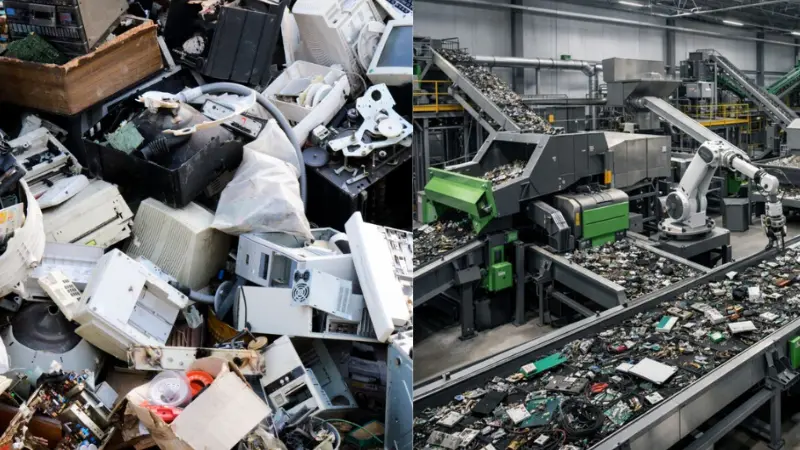
Companies in the US and Europe are dealing with rapidly increasing volumes of outdated electronics through a combination of IT Asset Disposition (ITAD), refurbishment, resale, manufacturer take-back programs, producer responsibility schemes, and certified recycling.
The US EPA recommends a lifecycle approach that prioritizes reducing material use, reuse, refurbishment, extending product life, and recycling. It also encourages organizations to use certified electronics recyclers.
In Europe, the approach is strongly influenced by WEEE (Waste Electrical and Electronic Equipment) rules. Producers and distributors have responsibilities for the collection, treatment, recovery, and recycling of electronic equipment at the end of its life.
1. Companies don’t immediately recycle old devices
This is probably the most important concept to explain.
Imagine a company has 10,000 old laptops.
A traditional approach might be:
Old → Waste → Recycler
A modern approach is more like:
Old → Inspect → Data wipe → Test → Grade → Reuse/Refurbish/Resell → Recycle what cannot be recovered
For example:
- 3,000 laptops may be redeployed internally.
- 4,000 may be refurbished and resold.
- 1,000 may be donated.
- 2,000 may be too damaged or obsolete and sent for material recycling.
The exact numbers vary, but the principle is important:
The objective is to get the maximum useful life and value from the equipment before it becomes material waste.
EPA itself describes sustainable electronics management as reducing, reusing, refurbishing, extending product life and recycling.
2. IT Asset Disposition Has Become a Major Industry
This is where your article can become much more interesting.
Large companies don’t usually want employees throwing old laptops into a recycling bin.
Instead, they use IT Asset Disposition (ITAD) programs.
ITAD can manage:
- Employee laptops
- Desktop computers
- Servers
- Hard drives
- SSDs
- Smartphones
- Tablets
- Monitors
- Networking equipment
- Printers
- Data-center equipment
A typical process is:
Asset inventory
↓
Secure collection
↓
Transportation
↓
Data destruction
↓
Testing
↓
Refurbishment
↓
Resale/redeployment
↓
Recycling
↓
Reporting
This creates an entire business ecosystem around old technology.
3. Data Security Comes Before Recycling
This is one of the biggest differences between household and corporate e-waste.
A five-year-old laptop isn’t just an old laptop.
It might contain:
- Customer data
- Employee information
- Financial records
- Passwords
- Emails
- Intellectual property
- Internal documents
So companies often treat an old computer as a data-security risk first and a recycling asset second.
In the US, EPA’s certified electronics recycler guidance specifically highlights data destruction as part of responsible electronics recycling.
A corporate process can therefore look like:
Laptop retired
→ Asset recorded
→ Data securely erased
→ Data destruction verified
→ Device tested
→ Device reused/resold
or
→ Device physically destroyed/recycled
That is a much stronger story than simply saying “companies recycle old computers.”
4. Working Electronics Are Often Refurbished
This is another major opportunity.
A company may retire a laptop because it is:
- Too old for the company’s software
- Being replaced by a newer model
- Outside its internal lifecycle policy
- No longer supported by IT
But that doesn’t necessarily mean the laptop is useless.
A professional recycler or ITAD company can test it.
If it works, it may be:
Wiped → Repaired → Upgraded → Refurbished → Resold
This creates a second-life market for electronics.
The same concept applies to:
- Smartphones
- Tablets
- Servers
- Monitors
- Networking equipment
- Gaming consoles
- Office electronics
5. Companies Recover Money From Old Electronics
This is a very important business angle.
E-waste isn’t always a cost.
Old technology can have residual value.
For example, a company replacing 5,000 laptops could potentially recover value from:
- Working laptops
- RAM
- SSDs
- CPUs
- Displays
- Power supplies
- Networking equipment
- Servers
This is why the modern industry often talks about asset recovery, rather than just recycling.
Instead of:
“How much will it cost us to recycle these?”
companies can ask:
“How much value can we recover before these assets are recycled?”
That changes the economics completely.
6. Retailers and Manufacturers Take Back Old Electronics
Western countries also have extensive take-back systems.
Manufacturers and retailers may collect old electronics when consumers buy new products or through dedicated recycling programs.
For example, the US EPA points consumers toward manufacturer and retailer recycling programs, including Best Buy’s electronics recycling program.
In Europe, WEEE rules require producers and distributors to contribute to appropriate end-of-life management, including collection and treatment arrangements.
This creates a system where responsibility doesn’t end when a company sells the product.
7. Europe Uses Extended Producer Responsibility
This is an especially good section if you want the article to have international depth.
Under the European WEEE framework, producers have responsibilities associated with products after they become waste.
Companies may need to:
- Register with national authorities
- Report quantities of electrical equipment placed on the market
- Organize or finance collection
- Support treatment and recycling
- Participate in collective compliance schemes or establish their own arrangements
The underlying idea is:
The company that puts electronics into the market has responsibility for helping manage those products when they reach end of life.
This is known as Extended Producer Responsibility (EPR).
8. Certified Recycling Is Becoming More Important
Western companies increasingly look beyond the question:
“Does this company recycle electronics?”
They ask:
“How do you recycle them, and can you prove it?”
The US EPA recognizes two accredited certification standards for electronics recyclers:
- R2 — Responsible Recycling
- e-Stewards
EPA says certified recyclers are audited against standards covering environmental management, worker and environmental protection, downstream management, reuse/recycling, and data destruction.
This is particularly important for corporate customers.
A business may want documentation showing:
- What equipment was collected
- Where it went
- What happened to the data
- What was reused
- What was recycled
- What materials were recovered
9. The “Downstream” Problem
This is something I would definitely add to your article, because many basic e-waste articles completely ignore it.
A company might give its electronics to Recycler A.
But Recycler A might send some materials to:
Recycler B → Processor C → Material recovery facility D
So a responsible company needs to understand the downstream chain.
The question isn’t simply:
“Who collected my laptop?”
It is:
“Where does my laptop ultimately go?”
EPA’s certified recycler framework specifically considers the safe management of materials by downstream handlers.
This gives you a powerful section:
What Happens After the Recycler Takes Your Electronics?
Collection
→ Sorting
→ Reuse/refurbishment
→ Dismantling
→ Material separation
→ Specialized processing
→ Raw material recovery
That makes the article much more sophisticated than a basic recycling guide.
10. Batteries Are Creating a New E-Waste Challenge
The technology industry is changing rapidly.
We’re moving from traditional electronics toward:
- Smartphones
- Electric vehicles
- E-bikes
- Power banks
- Wireless earbuds
- Smart devices
- Energy storage systems
- Portable batteries
This means battery waste is becoming increasingly important.
Lithium-ion batteries require special attention because damaged batteries can create fire hazards. The US EPA specifically advises against putting lithium-ion batteries and devices containing them in household garbage or recycling bins.
So the future of e-waste isn’t just:
Old computers + old TVs
It increasingly includes:
Electronics + batteries + energy-storage equipment.
11. Electronics Are Becoming Obsolete Faster
This is the bigger story behind the article.
Technology companies continuously release:
- New smartphones
- New laptops
- New processors
- New gaming consoles
- New AI hardware
- New networking equipment
- New smart-home products
- New wearables
At the same time, software support ends.
A perfectly functional device can become commercially obsolete even though the hardware still works.
That creates an interesting problem:
When does an electronic device become waste?
It may be physically functional but economically obsolete.
That is why refurbishment, resale, repair and reuse are becoming increasingly important.
12. The Future Is Moving From “Recycling” to “Circular Electronics”
This is where I’d take your article beyond your competitors.
The traditional model is:
Manufacture → Sell → Use → Throw Away
The emerging model is:
Manufacture → Sell → Use → Repair → Reuse → Refurbish → Resell → Recover Components → Recycle → Manufacture Again
That’s the circular economy approach.
The EU explicitly connects WEEE management with reuse, recycling, resource efficiency and recovery of valuable secondary raw materials.
So the future isn’t simply:
More recycling.
It is:
Less waste + longer product life + more reuse + more refurbishment + better material recovery.