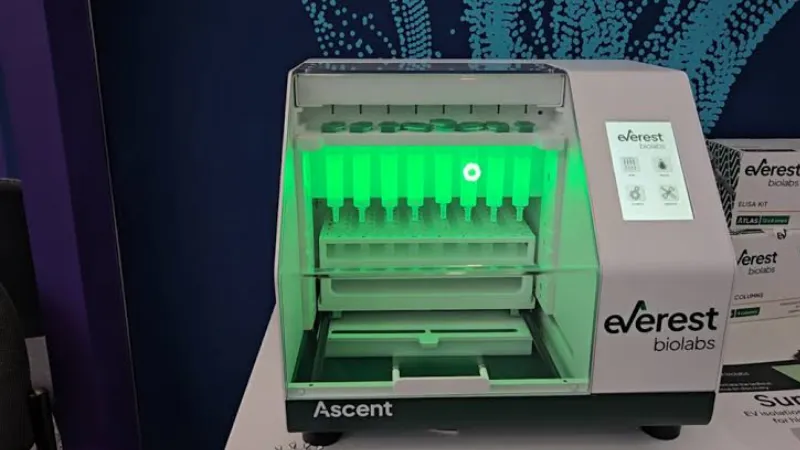
Everest Biolabs, a Waltham, Massachusetts-based biotechnology company, has received a $2.1 million Small Business Innovation Research (SBIR) Direct-to-Phase II grant from the National Institute of General Medical Sciences (NIGMS), part of the National Institutes of Health (NIH).
The company will use the funding to advance its automated technology for isolating extracellular vesicles (EVs) from blood samples at clinical scale.
EVs are tiny particles released by cells that carry proteins and other biological information from the tissues where they originate. Researchers are studying EVs as potential sources of disease-related biomarkers.
Everest Biolabs is developing a plate-based platform that can process large numbers of samples in parallel. The company also plans to advance its Apex columns, which are designed to isolate higher-purity EVs from plasma.
The technology aims to help researchers identify disease-related proteins that can be difficult to detect in blood because they are present at very low levels.
“The proteins that tell us the most about disease are the hardest to see in blood, and EVs are how we get to them,” said Tal Gilboa, co-founder, head of research and principal investigator for the project.
Everest CEO and co-founder George Daaboul said the grant supports the company’s work to develop scalable and standardized EV isolation technology for applications including biomarker discovery, diagnostics and therapeutics.
Founded in the field of EV research, Everest has developed automated EV isolation systems, SEC columns and ELISA kits for EV quantification and purity assessment. The company launched its Ascent and Summit instruments and Apex column family after emerging from stealth in 2024.
The new NIH funding will support Everest Biolabs’ research and development efforts as it works to make EV isolation faster, more consistent and suitable for larger clinical sample volumes.