Amsterdam-based MedTech startup Phosphoenix has raised €1.3 million in a new funding round. The company is developing a neuroprosthetic system designed to help people with severe blindness.
The company will use the funding to prepare for its first clinical study involving humans. The money will also support further development of its neurostimulation technology.
The round includes continued investment from existing backers, including TTT Medtech Fund, managed by 819 Capital, FIRST Fund, managed by BioGeneration Ventures, and Innovatiefonds Noord-Holland. New investor ROM InWest also participated.
Hans Brons, Chief Executive Officer of Phosphoenix, commented, “This financing represents an important step towards bringing our technology into the clinic. The continued support of our existing investors, together with the commitment of ROM InWest, provides strong validation of the progress we have made and enables us to advance our first-in-human preparations while building towards our Series A financing. Our ultimate goal is to restore meaningful functional vision to people living with profound blindness.”
Phosphoenix was founded in 2019 by Prof. Pieter Roelfsema, Prof. Xing Chen, and Dr. Bert Monna. The company is a spin-off from the Netherlands Institute for Neuroscience (NIN), which is part of the Royal Netherlands Academy of Arts and Sciences (KNAW).
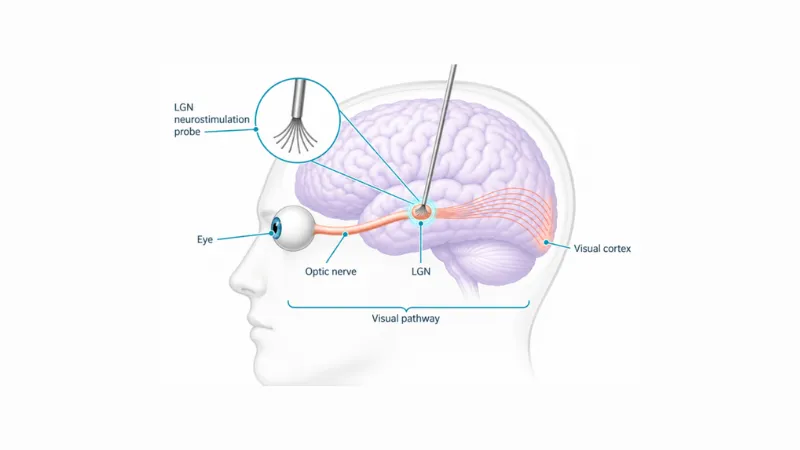
The company is developing a brain implant designed to stimulate nerve cells involved in vision. Phosphoenix says its goal is to help people with severe blindness regain useful vision, as damage to the retina or optic nerve currently has limited treatment options.
Phosphoenix is developing its system to directly stimulate the lateral geniculate nucleus (LGN), an important part of the brain’s visual pathway. The company aims to use this approach to help people with profound blindness achieve meaningful functional vision.
At the centre of the system is the Fountain Probe, a neural interface with more than 1,000 tiny electrodes. The device is designed to bypass damaged parts of the eye and optic nerve by sending electrical signals directly to the brain. Phosphoenix plans to implant the probe in the LGN using stereotactic surgery techniques similar to those used in deep brain stimulation.
Sara Schaafsma, senior investment manager LSH at ROM InWest, said, “Phosphoenix is developing a potentially life-changing technology for people living with profound blindness. We are impressed by the combination of scientific excellence, strong clinical relevance, and the team’s progress towards clinical validation. With its roots in Amsterdam through the Netherlands Institute for Neuroscience, Phosphoenix is also an excellent example of how scientific innovation from our region can translate into societal impact. We are pleased to support the company as it advances towards its first-in-human study.”
Phosphoenix will use the new funding to prepare for its first clinical study involving humans and to further develop its neurostimulation system.
The company is also preparing for a Series A funding round. The new funding will support its clinical development programme and help move the technology toward human trials.