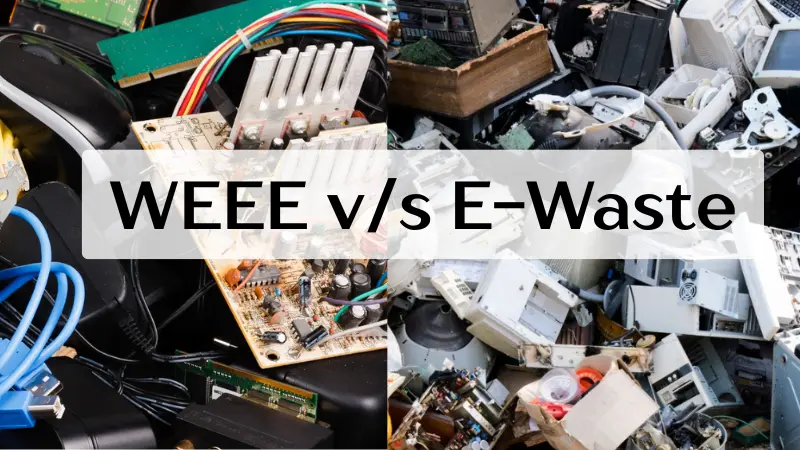
Most people have probably heard the term e-waste.
You may have an old mobile phone in a drawer, a laptop that stopped working years ago, a pile of chargers you no longer use, or an old printer sitting somewhere in the office.
When these products are no longer wanted or usable, people usually call them e-waste.
But when you start reading about electronic waste management, recycling regulations, or professional recycling services, another term often appears:
WEEE — Waste Electrical and Electronic Equipment.
At first, this can be confusing.
Are WEEE and e-waste the same thing?
Or is there an actual difference between them?
The short answer is that they are very closely related and are often used to describe the same type of discarded electrical and electronic products. The main difference is usually in how and where the terms are used.
The Simple Difference Between WEEE and E-Waste
Here is the easiest way to understand it:
E-waste is the common, everyday term for discarded electronics. WEEE is the more formal term used in waste management, regulation, and recycling systems.
For example, if you are talking to a friend, you are more likely to say:
“I need to get rid of my old e-waste.”
But a recycling company, government authority, or waste-management document may refer to:
“WEEE collection and recycling.”
In everyday use, both terms may refer to items such as:
- Mobile phones
- Laptops
- Computers
- Televisions
- Printers
- Chargers
- Cables
- Refrigerators
- Air conditioners
- Washing machines
- Small electrical appliances
However, the terminology can become more specific depending on regulations and the country.
What Is E-Waste?
E-waste is short for electronic waste.
It is the commonly used term for electrical and electronic products that have been discarded, are no longer wanted, or have reached the end of their useful life.
A simple real-life example is an old smartphone.
Imagine you bought a new phone three years ago. Your old phone was placed in a drawer because you thought you might use it again.
A year passes.
Then another.
Eventually, the phone is no longer useful to you.
At that point, it may become e-waste.
The same situation happens with millions of electronic products.
A laptop becomes too slow.
A television stops working.
A charger no longer fits a new device.
A company replaces 100 old computers with newer ones.
These unwanted electronic products are commonly described as e-waste.
What Is WEEE?
WEEE stands for Waste Electrical and Electronic Equipment.
The term is commonly associated with formal waste-management systems and regulations, particularly in regions where electrical and electronic waste is classified and managed under specific legal frameworks.
WEEE generally refers to electrical and electronic equipment that has become waste.
This can include:
- Household electronics
- Office equipment
- IT equipment
- Large appliances
- Small appliances
- Consumer electronics
- Electrical accessories
The term is especially useful in professional contexts because it clearly identifies waste from electrical and electronic equipment as a specific waste stream.
The Real-Life Way to Think About It
Imagine two people looking at the same old laptop.
The first person says:
“This is old e-waste. I don’t use it anymore.”
The second person works in waste management and says:
“This equipment needs to be handled through the WEEE recycling process.”
They are talking about the same old laptop.
The difference is mainly the language and context.
E-waste is the more familiar and general term.
WEEE is often the more formal and industry-specific term.
WEEE vs E-Waste: Quick Comparison
| WEEE | E-Waste |
|---|---|
| Stands for Waste Electrical and Electronic Equipment | Stands for Electronic Waste |
| More formal and technical term | More common everyday term |
| Frequently used in regulations and waste-management systems | Commonly used by the public and media |
| Focuses specifically on electrical and electronic equipment that has become waste | Broadly refers to discarded electronic products |
| Often used by recyclers, authorities, and compliance professionals | Often used in general conversations and environmental discussions |
Are WEEE and E-Waste Exactly the Same?
In many situations, people use the terms interchangeably.
However, it is useful to understand that WEEE can have a more specific legal or regulatory meaning depending on the country or region.
Regulations may define:
- What types of equipment are included
- How equipment is categorised
- Who is responsible for collection
- How products should be treated
- Recycling and recovery requirements
- Producer responsibilities
Because of this, a professional recycling or compliance document may prefer the term WEEE instead of simply saying e-waste.
In general content, however, saying e-waste is usually easier for readers to understand.
Why Do Two Different Terms Exist?
The reason is largely about audience and context.
E-Waste Is Easier for Everyday Readers
If you ask someone:
“Do you have any e-waste at home?”
They will probably understand that you mean old electronics.
But if you ask:
“Do you have any WEEE?”
Many people may not immediately understand the abbreviation.
This is why websites targeting consumers often use e-waste.
WEEE Is Common in Professional and Regulatory Discussions
WEEE is more likely to appear in:
- Recycling regulations
- Government documents
- Compliance requirements
- Waste-management reports
- Environmental policies
- Professional recycling services
For businesses dealing with electronics at scale, WEEE can be an important term because equipment may need to be handled according to specific requirements.
Examples: Is It WEEE or E-Waste?
Let’s make it simple.
An old mobile phone
You could call it:
- E-waste
- WEEE
A broken laptop
You could call it:
- E-waste
- WEEE
An old office printer
You could call it:
- E-waste
- WEEE
A refrigerator being discarded
You could call it:
- Electrical waste
- WEEE
- E-waste in general discussion
The terminology may change depending on who is talking and which regulations apply.
Why the Difference Matters for Businesses
For an individual, the difference between WEEE and e-waste may not seem important.
You simply want to know:
“Where can I responsibly dispose of this old device?”
For a business, however, terminology can become more important.
A company may have large quantities of:
- Computers
- Laptops
- Servers
- Hard drives
- Monitors
- Mobile phones
- Printers
- Networking equipment
When these assets reach the end of their useful life, businesses need to think about more than recycling.
They may also need to consider:
- Data security
- Equipment tracking
- Collection
- Reuse and refurbishment
- Environmental compliance
- Documentation
- Responsible recycling
In this context, WEEE management may be part of a wider IT asset disposal and sustainability strategy.
WEEE and E-Waste Both Need Responsible Management
Regardless of which term you use, the important issue remains the same:
What happens to electronics when we stop using them?
An old device should not automatically be treated as useless rubbish.
Before recycling, ask:
Can it still be used?
If yes, continue using it.
Can it be repaired?
Repairing a device may extend its useful life.
Can it be reused?
Someone else may still be able to use it.
Can it be refurbished?
A professional refurbishment process may return the equipment to use.
Is it no longer usable?
Then responsible recycling may be the right option.
A useful order to remember is:
Reuse → Repair → Refurbish → Recycle
What Happens When WEEE or E-Waste Is Recycled?
Whether a recycler calls it WEEE recycling or e-waste recycling, the general goal is similar.
The equipment may go through several stages:
Collection → Sorting → Data Handling → Dismantling → Material Separation → Recycling
Depending on the equipment, materials may include:
- Metals
- Plastics
- Glass
- Circuit boards
- Cables
- Batteries
Professional recycling processes can separate different materials and direct them into appropriate recovery or recycling streams.
For IT equipment, data security may also be an important step before reuse or recycling.
Should You Use “WEEE” or “E-Waste” in Your Content?
If your audience is the general public, e-waste is usually easier to understand.
For example:
“How to Recycle E-Waste”
is immediately clear to most readers.
However, if you are writing for:
- Recycling professionals
- Environmental managers
- Corporate sustainability teams
- Compliance professionals
- Government-related audiences
then WEEE may be more appropriate.
A good approach for a website is to use both naturally.
For example:
“WEEE (Waste Electrical and Electronic Equipment), commonly known as e-waste, includes discarded electrical and electronic products such as computers, mobile phones, appliances, and other electronic equipment.”
This helps both readers and search engines understand the relationship between the two terms.
Final Thoughts
So, what is the difference between WEEE and e-waste?
For most people, the difference is simple:
E-waste is the everyday term. WEEE is the more formal term commonly used in professional, waste-management, and regulatory contexts.
Both are concerned with the same important question:
What should happen to electrical and electronic equipment when we no longer use it?
Whether it is an old phone in a drawer, a broken laptop at home, or hundreds of outdated computers in an office, responsible management starts with thinking beyond simply throwing electronics away.
Before disposing of an electronic product, consider whether it can be:
Reused. Repaired. Refurbished. Or responsibly recycled.
Because regardless of whether we call it WEEE or e-waste, the way we manage discarded electronics matters.